
India's TEJAS MK-2 Reveals Advanced Cockpit Features Through Simulator Demonstration

The Aeronautical Development Agency (ADA) has unveiled the advanced cockpit design of India's upcoming TEJAS MK-2 fighter jet through a detailed simulator demonstration, marking a significant technological leap for the country's indigenous 4.5-generation combat aircraft program. The simulator provides the first comprehensive look at the modernised cockpit that prioritizes automation, pilot efficiency, and next-generation interface design.
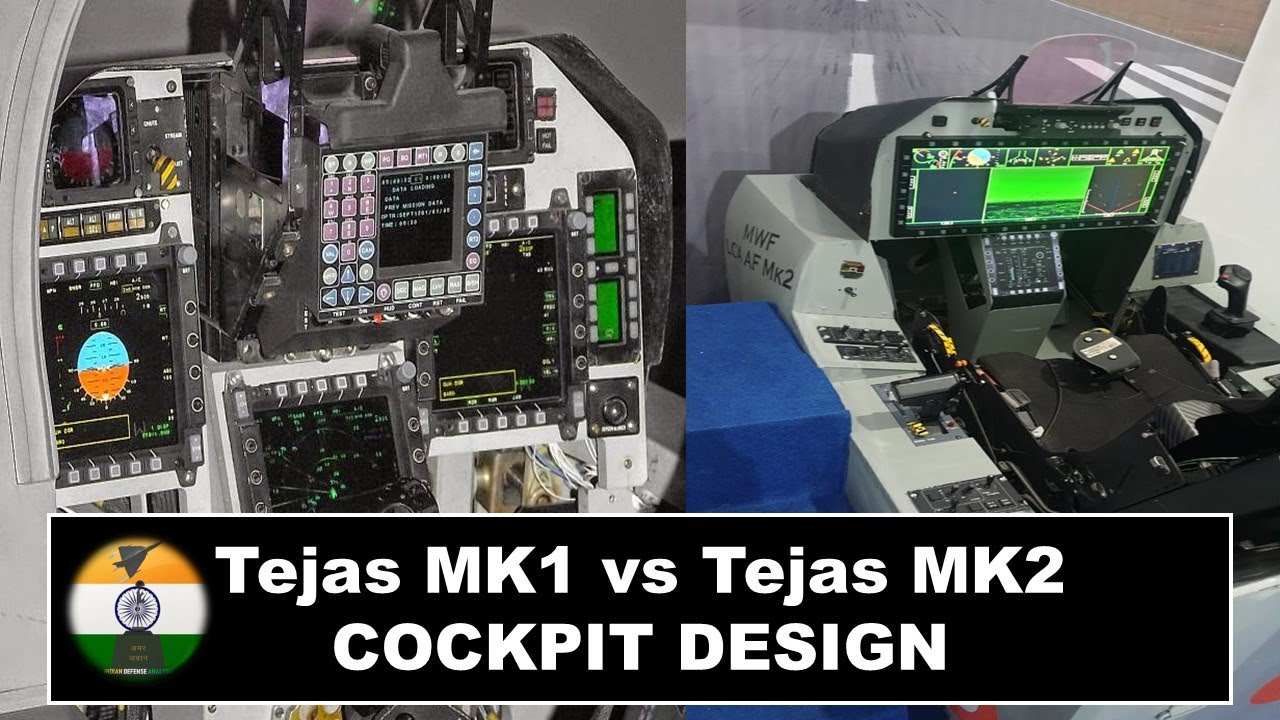
Comparison of TEJAS MK-1 and MK-2 cockpits shows the transition from multiple smaller screens and many switches to a modern large touch screen and simplified controls in the MK-2
Revolutionary Cockpit Design Philosophy
The TEJAS MK-2 cockpit represents a fundamental shift from traditional fighter aircraft interfaces, with Wing Commander Siddharth, a former TEJAS MK-1 pilot now working with ADA, explaining that the design focuses on reducing pilot workload and enhancing combat effectiveness. "This cockpit has been designed keeping in mind the new generation of pilots, new generation of weapons, and new generation of systems," according to Wing Commander Siddharth.
The new design philosophy emphasises converting pilots from system operators into tactical decision-makers. Unlike its predecessor, the MK-2 significantly reduces the number of manual switches and instead relies on automated systems that activate based on situational requirements.
Many critical systems, including radar and missile activation, now operate automatically without requiring pilot intervention, with the aircraft's computer systems providing status updates to the pilot.
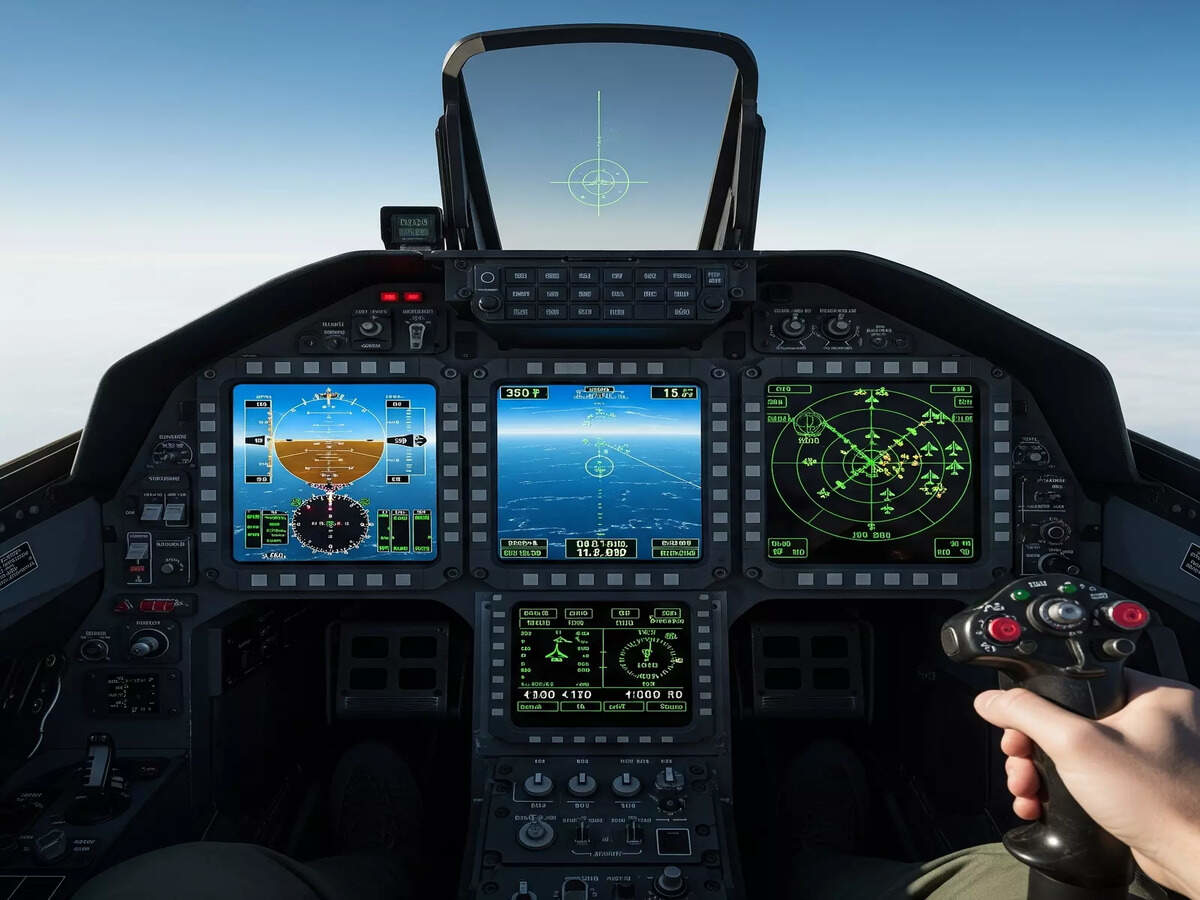
MK-2 simulator cockpit with large touch screen & side joystick controls with fewer switches
Large Area Display And Touch Interface
The centrepiece of the TEJAS MK-2 cockpit is its Large Area Display (LAD), a wide-format touchscreen measuring approximately 50x20cm (20x8 inches). This high-definition display serves as the primary interface for tactical and flight data, replacing multiple smaller screens found in the Mk1 variant. The LAD provides intelligent presentation of information across its entire length and can receive inputs from multitask keys, touchscreen interaction, or external interfaces
The touch-enabled interface allows pilots to perform critical functions such as target selection and waypoint navigation with simple touch commands, significantly streamlining cockpit operations. This modern approach caters to the current generation of pilots who are more familiar with touchscreen technology and intuitive user interfaces.
HOTAS Integration And Ergonomic Controls
The TEJAS MK-2 incorporates an advanced Hands-On Throttle and Stick (HOTAS) system that integrates essential controls including communications, weapon release, and electronic warfare functions directly into the throttle and stick. This design ensures pilots can access critical controls without removing their hands from primary flight controls, reducing reaction times during combat situations.
The aircraft features ergonomically positioned joysticks on both left and right sides for throttle and stick functions, strategically placed to minimize pilot movement and maximize accessibility during high-stress combat scenarios. The side-stick controller design, similar to those found in the Dassault Rafale and F-35 Lightning II, helps reduce cockpit clutter while improving pilot control precision.
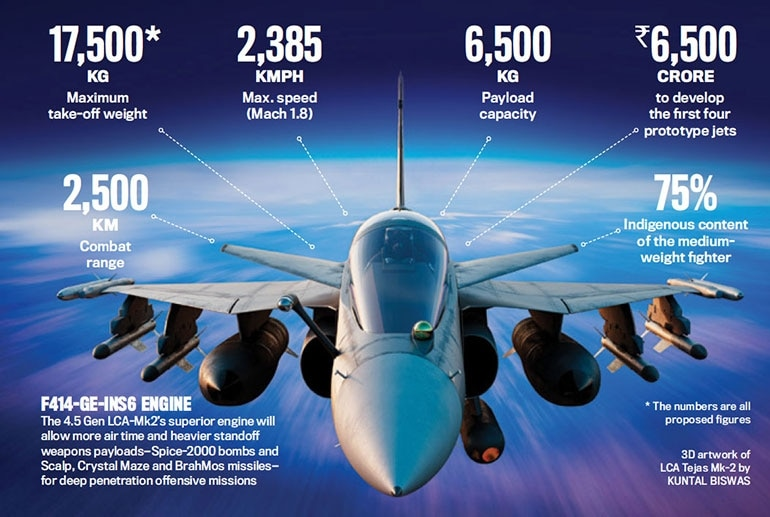
Key specifications-capabilities of the TEJAS MK-2 illustrated in 3D digital artwork Indiatoday image
Advanced Sensor Fusion Capabilities
The TEJAS MK-2 incorporates sophisticated sensor fusion technology that combines inputs from multiple sensors to create a unified tactical picture for the pilot. This system integrates data from the aircraft's Active Electronically Scanned Array (AESA) radar, Infrared Search and Track (IRST) system, Radar Warning Receiver (RWR), and Missile Approach Warning System (MAWS).
The sensor fusion algorithms unify data from various sources to create cohesive target tracks, providing enhanced situational awareness and improved threat prioritization. The system can identify threats, classify friendly and enemy aircraft, and suggest optimal engagement strategies, significantly reducing cognitive load on pilots while improving tactical decision-making speed.
Electronic Warfare And Defensive Systems
The aircraft features an integrated electronic warfare suite that includes a Radar Warning Receiver and Missile Approach Warning System to detect tracking radars and incoming threats. These systems provide early warning capabilities that support timely defensive manoeuvres and countermeasure deployment.
The electronic warfare systems work in conjunction with the sensor fusion technology to provide comprehensive threat assessment and response recommendations, enhancing the aircraft's survivability in contested environments.
Enhanced Weapon Systems Integration
The TEJAS MK-2 boasts 11 hardpoints capable of carrying up to 6,500 kg of payload, representing a significant improvement over the MK-1's capabilities. The aircraft can carry up to 10 Beyond Visual Range (BVR) missiles simultaneously, with officials noting that no other single-engine aircraft in its class can match this capability.
Target acquisition is simplified through a Target Designate Button and cursor control system, allowing pilots to lock onto targets and engage using integrated trigger controls without removing hands from critical flight controls. The aircraft is compatible with precision weapons including SCALP, SPICE, and HAMMER missiles.
Environmental And Life Support Systems
The cockpit incorporates advanced environmental controls that maintain a consistent temperature of 25-26°C even in extreme conditions as low as -56°C. A canopy demist function manages fog and moisture issues, ensuring optimal visibility during operations.
The aircraft features an integrated autopilot system that manages four dimensions—position, altitude, time, and speed—allowing pilots to rely on automation for route execution while focusing on tactical responsibilities. An On-Board Oxygen Generation System (OBOGS) enables extended missions without external oxygen supply.
Performance And Operational Capabilities
With improved fuel capacity of 3,300 kg internally and up to 6,000 kg with external tanks, the TEJAS MK-2 can conduct patrol missions lasting up to 3.5 hours. With mid-air refuelling capabilities, operational duration can extend to 10 hours, dramatically improving the aircraft's strategic value.
The enhanced fuel capacity and payload capabilities represent a threefold increase in sortie duration compared to the MK-1, which typically operates for approximately 45 minutes. This improvement fundamentally transforms the aircraft's role in air defence and Combat Air Patrol (CAP) missions.
Summary
The TEJAS MK-2 simulator demonstration marks a significant milestone in India's indigenous defence aviation program, showcasing advanced cockpit technology that positions the aircraft as a competitive 4.5-generation fighter capable of meeting modern combat requirements while maintaining cost-effectiveness compared to Western alternatives.
IDN (Synthesised From ET News Report)


No comments:
Post a Comment