Showing posts with label JMB. Show all posts

Saturday, June 27, 2026

NIA Charges Eleven Over JMB Offshoot’s Expansion Plot In India


The National Investigation Agency has filed charges against eleven individuals in connection with a terror conspiracy linked to Imam Mahmuder Kafila, an offshoot of the proscribed Jamaat-ul-Mujahideen Bangladesh.

The chargesheet was submitted before the NIA Special Court in Guwahati under provisions of the Bharatiya Nyaya Sanhita, 2023, and the Unlawful Activities (Prevention) Act, 1967.

This marks a significant step in India’s ongoing efforts to dismantle extremist networks attempting to expand their footprint across the eastern and north-eastern regions.

Investigations revealed that Imam Mahmuder Kafila was established by senior JMB member Imam Mahmud Habibullah to propagate the banned outfit’s ideology on Indian soil. The accused were found to be actively involved in promoting the organisation’s extremist agenda, radicalising vulnerable youth, and expanding its network in states such as West Bengal, Assam, and Tripura.

Their activities included clandestine meetings, indoctrination programmes, circulation of extremist literature, and the use of digital platforms to spread anti-India propaganda and foster allegiance to IMK/JMB leadership.

Two of the accused have been identified as Nasimuddin, who spearheaded IMK’s operations in Assam, and Jagir Mia, who led the outfit in Tripura. The NIA uncovered incriminating documents, electronic devices, and digital records during the investigation, which provided crucial evidence of the conspiracy. 

These materials are expected to play a pivotal role in establishing the extent of the network’s operations and its attempts to destabilise the region.

The chargesheet underscores the evolving nature of terror threats in India, where banned organisations are increasingly relying on digital platforms and covert indoctrination to expand their reach. By targeting vulnerable communities and exploiting religious sentiments, IMK sought to build a base of radicalised recruits capable of advancing its violent agenda.

The NIA’s action highlights the importance of combining traditional investigative methods with digital forensics to counter such threats effectively.

This case also reflects the broader regional challenge posed by cross-border extremist organisations like JMB, which have historically attempted to infiltrate India’s eastern frontier.

The dismantling of IMK’s network is seen as a crucial step in preventing the spread of radicalisation and ensuring that extremist ideologies do not gain traction among susceptible populations. Authorities believe that exposing these conspiracies will not only weaken the operational capacity of such groups but also deter future attempts to rebuild similar networks.

Agencies


Thursday, January 1, 2026

'Pak Ministers Stalk Indian Leaders': Ex-Envoy Mocks 'Laughable' Reports of EAM's Dhaka Handshake


Former diplomat Suresh K Goel dismissed Pakistani reports of a handshake between External Affairs Minister S Jaishankar and Pakistan's National Assembly Speaker Ayaz Sadiq as laughable.

The brief interaction occurred on the sidelines of former Bangladesh Prime Minister Khaleda Zia's funeral in Dhaka. Goel remarked that Pakistani ministers tend to "stalk" Indian leaders, eagerly approaching them in hopes of sparking change despite ongoing hostilities.

In an ANI interview, Goel highlighted the current climate of tension, citing continued terrorism from Pakistan into Indian territory. He pointed to Pakistan Army Chief Asim Munir's flaunting of military prowess and the re-establishment of terrorist bases by the Pakistani army and ISI.

Goel emphasised that such actions mock Indian victories and falsify events, rendering any perceived diplomatic overture absurd.

Pakistan's National Assembly Secretariat issued a press release claiming Jaishankar approached Sadiq for the handshake, as reported by Dawn. Pakistani media amplified the gesture, framing it as a potential diplomatic opening amid strained ties. Indian sources, however, described it as mere protocol at a funeral, not substantive engagement.

India-Pakistan relations deteriorated sharply following the Pahalgam terror attack on 22 April 2025, where militants killed 26 tourists, mostly Hindus, in Jammu and Kashmir. The Resistance Front, linked to Lashkar-e-Taiba, initially claimed responsibility before retracting it. India accused Pakistan of sponsoring cross-border terrorism.

In response, India suspended the Indus Waters Treaty, expelled Pakistani diplomats, closed border crossings, and imposed visa bans. Pakistan retaliated by suspending the Simla Agreement, restricting trade, and closing airspace, leading to skirmishes along the Line of Control.

The crisis escalated on 7 May 2025 with India's Operation Sindoor, involving precision missile strikes on nine terror camps of Jaish-e-Mohammed, Lashkar-e-Taiba, and Hizbul Mujahideen in Pakistan and Pakistan-occupied Kashmir. India reported over 100 militants killed, avoiding civilian or military targets. Pakistan claimed civilian casualties, including mosques.

A ceasefire followed on 10 May 2025 after India repelled Pakistani escalation and targeted airbases. India has maintained that future engagement requires Pakistan to dismantle terror infrastructure and ensure a terrorism-free environment.

This Dhaka handshake marks rare high-level contact since the 2025 conflict, contrasting with prior acrimony like the 2023 SCO meeting. Neither side planned bilateral talks at the funeral, underscoring persistent distrust. Goel's comments reflect India's firm stance against normalising ties without accountability for terrorism.

Pakistan's eagerness to spotlight the handshake reveals desperation in its leadership, as Goel noted. Amid economic woes and internal challenges, Islamabad seeks any narrative of thaw. India, however, prioritises national security, viewing such gestures as incidental rather than transformative.

The episode at Khaleda Zia's funeral—attended by global dignitaries—highlights Bangladesh's delicate balancing act between India and Pakistan. Jaishankar's attendance signalled India's balanced regional diplomacy, even as it rebuffs Pakistani overtures.

Based On ANI Report


Sunday, May 25, 2025

India Tightens Security Along Bangladesh Border After Intel Warns of Terror Threat


India has tightened security along its border with Bangladesh following credible intelligence warnings of a potential terror threat. This move comes amid rising extremist activities and ongoing political instability in Bangladesh, which have raised concerns about cross-border infiltration and the resurgence of banned terror outfits, particularly Jamaat-ul-Mujahideen Bangladesh (JMB).

A high-level security review meeting was convened in early May, bringing together top officials from central and state security agencies. The meeting focused on strengthening the security grid across all travel routes—land, air, and water—that connect India and Bangladesh. Intelligence agencies highlighted the alarming increase in JMB activities, referencing a recent public rally in Dhaka where the group displayed its flags and expressed support for Hamas, further intensifying Indian security concerns.

Investigations by West Bengal Police have revealed that JMB operatives arrested in the state were acting under the direction of handlers based in Pakistan, exposing a cross-border dimension to the threat. In response, the Border Security Force (BSF) has begun restructuring its deployment plan, increasing patrols in vulnerable regions, especially in West Bengal, where the porous border is often exploited for illegal infiltration.

Additional measures include heightened surveillance at airports in West Bengal and the Northeast, particularly on flights arriving from Bangladesh. The Central Industrial Security Force (CISF) and local police have been instructed to intensify passenger checks and scrutiny in these areas. Security advisories have also been issued to enhance vigilance and extend checks at critical transit points.

Beyond immediate security measures, India has imposed restrictions on certain imports from Bangladesh, including essential goods such as sugar, through two key ports. While these restrictions are officially attributed to addressing trade imbalances, they also reflect heightened national security concerns linked to the current threat environment.

Officials emphasise that these actions are precautionary, based on actionable intelligence regarding the movement of radicalised individuals in border areas. As diplomatic engagement continues and the security landscape evolves, India remains resolute in reinforcing its eastern flank and monitoring developments in Bangladesh to pre-empt any emerging threats.

Agencies


Tuesday, November 28, 2023

6 Bangladeshis Detained In Jammu


Jammu: Six Bangladeshi women and girls, who had illegally crossed into India, were detained by police from two separate localities here, officials said on Monday.

Preliminary investigation suggests that five of them had reached Jammu with the help of a tout and were heading for Kashmir when they were picked up from Bathindi, they said.

Another woman, also a Bangladeshi national who got married in Ramban district of Jammu, was held from Gandhi Nagar. She was supposed to accompany the other women and girls to Kashmir, officials said.

Those detained are aged between 14 and 60 years, they said.


Thursday, November 2, 2023

Crude Bombs Hurled At Maitree Express Train In Bangladesh's Pabna, None Hurt


Dhaka: Unidentified attackers hurled two crude bombs at the Maitree Express train near Ishwardi junction in Bangladesh's Pabna on Wednesday afternoon, as reported by Dhaka Tribune.

The Dhaka Tribune is a Bangladeshi English-language daily newspaper based in Dhaka.

No major damage or injury to any of the passengers was reported in the incident as the crude bombs exploded beside the passing train. The incident took place at around 12 noon as the train from Kolkata was heading towards Dhaka.

Ishwardi Railway police station Officer-in-Charge (OC) Harunuzzaman Rumel confirmed the incident and said that an object was thrown at the Maitree Express, resulting in damage to a window of the train compartment.

No injuries were reported, and the train continued its journey as scheduled. However, signs of arson were discovered at the scene, the officer said.

Pabna Additional Superintendent of Police (Administration-Finance) Masud Alam said, "Two crude bombs were hurled at the train, damaging one of the train's windows. Fortunately, there was no further damage. We are investigating the matter thoroughly", Dhaka Tribune reported.

Meanwhile, some unidentified individuals vandalized a bus before setting it on fire in Karnafuli upazila of Chittagong early on Wednesday, the second day of a blockade called by the (Bangladesh Nationalist Party) BNP.

"The bus was heading towards Karnafuli to Patiya after dropping off garment workers at their factory. Seeing blockaders ahead, the bus tried to return. They later intercepted the bus and set it on fire," Karnafuli police station OC Jahir Hossain told reporters, as per Dhaka Tribune.

The driver and his assistant had managed to escape with their lives as they had gotten off the bus quickly, he added.

The police, and fire service personnel rushed to the spot upon receiving the information and brought the blaze under control.

The police were trying to nab those involved in the arson attack, the OC said.

The US has expressed concern about the current electoral atmosphere in Bangladesh, specifically in the lead-up to the national election scheduled for January.

The country has underlined its unwavering commitment to closely monitoring the situation and taking incidents of violence seriously, as per Dhaka Tribune.

During a routine briefing held at the US Department of State on Tuesday, spokesperson Matthew Miller stressed Washington's active engagement with various stakeholders in Bangladesh, including the government, opposition and civil society, saying the primary objective of these engagements was to encourage collaboration among these groups for the benefit of the Bangladeshi people and to ensure a free and fair election conducted in a peaceful manner.

"We do believe that dialogue is important to achieving those goals," he said.

Miller said holding free and fair elections is the responsibility of everyone - all political parties, voters, government, civil society and the media.

"And what we want in Bangladesh is the same thing the Bangladeshi people want, which are free and fair elections conducted in a peaceful manner," the US State Department spokesperson said.


Sunday, July 30, 2023

Four Explosions Reported In Bangladesh'S Aminbazar, Six Crude Bombs Recovered


Dhaka: Four explosions have been reported in Aminbazar, Savar, the entrance to Dhaka, reported The Dhaka Tribune.

The explosions of the crude bomb-like items occurred on the road in front of a filling station in Aminbazar on the Dhaka-Aricha highway at around 2 pm (local time) on Saturday.

Later, the authorities discovered six brand-new homemade bombs close to the explosion scene in a paper bag that had been left beside a three-story structure on the side of the road, according to Dhaka Tribune.

Quoting witness Saiful Islam, Dhaka Tribune reported that a moving pickup van threw four to five homemade bomb-like items onto the side of the road.

Locals reported hearing the explosion's loudness from a few hundred yards away.

The manager of the petrol station, Nurul Amin, said that no one was present when the explosions took place, Dhaka Tribune reported.

Law authorities in the meantime submerged the six homemade bombs in a bucket of water to defuse them after finding them.


Monday, May 22, 2023

Gujarat ATS Busts Active Cell of 'Al-Qaeda', 4 Illegal Bangladeshi Immigrants Held


Ahmedabad: Gujarat Anti-Terrorism Squad (ATS) has busted an active cell of the militant organisation 'Al-Qaeda' with the arrest of four Bangladeshi nationals, the officials said on Monday.

The accused have been identified as Mohammed Sojibmiya, Munna Khalid Ansari, Azarul Islam Ansari and Abdul Latif.

"Based on the intel received, four illegal Bangladeshi immigrants working to recruit for 'Al-Qaeda' were arrested," Gujarat ATS DIG Deepan Bhadran said.

According to the ATS, the accused attempted to radicalize people in Gujarat and sent money to Bangladesh as well.

"Gujarat, ATS got information that four Bangladeshi nationals were living illegally in Ahmedabad's Odhav and Narol area on duplicate IDs. They are associated with Al-Qaeda and are motivating the muslim people of the city to join the militant organisation and are collecting funds as well for Al-Qaeda," the official statement said.

Fake documents and incriminating literature were recovered from their home.

"The ATS during search operation got hold of duplicate Aadhaar card and PAN card from the accused as well as documents printed by the Al-Qaeda Media wing," it said.

A case has been registered against the four under Sections 38, 39 and 40 of IPC," the statement added further.


Wednesday, May 10, 2023

16 Held For 'Links' With Radical Outfit HuT; MP Police Say It Wanted To Topple India's Democratic System


The Madhya Pradesh police's Anti-Terrorism Squad (ATS) on Tuesday arrested 11 persons from two cities in the state, while five others were nabbed from Hyderabad for their suspected links with the Hizb-Ut-Tahrir (HUT), a radical outfit, an MP police spokesman said.

With these arrests, police authorities claimed to have busted a module of the fundamentalist organisation.

The MP ATS arrested 11 persons, including a gym trainer, software engineer and teacher, and booked them under the Unlawful Activities (Prevention) Act (UAPA) and other relevant provisions of the IPC, an official said.

Of these, 10 were arrested from Bhopal's Shahjahanabad, Aishbagh, Lalghati and Pipalani areas, while one was nabbed from Chhindwara city, he said.

Following a tip-off from the ATS, the Telangana police arrested five persons from Hyderabad for their alleged links with the outfit, he said.

The official said anti-national documents, electronic equipment and radical literature were recovered from the arrested members of HUT, whose network is spread in more than 50 countries. The outfit has already been banned in 16 countries, he said.

The MP police spokesman claimed the organisation was aiming to topple the democratic system in India and replace it with Sharia (Islamic law regime).

The outfit was working to create its cadres in Madhya Pradesh and instigate them for violence, he alleged.

The spokesman said those arrested included a gym trainer, teacher, auto driver, tailor, computer technician, businessman and software engineer, and claimed they used to organise secret combat training camps in forest areas.

They received training from skilled trainers from Hyderabad, he said. Besides, they used to deliver provocative speeches at religious meetings and distribute religious literature to rope in more youths, said the spokesman.

The spokesman said they avoided regular channels of communication and used dark webs for conversation.

He said these HUT members had identified big cities of India to commit violent incidents in crowded areas to create panic.

Last year, several people were arrested from Bhopal for their alleged links with the banned group Jamaat-ul-Mujahideen Bangladesh (JMB), and jihadi literature and electronic devices seized from them.


Tuesday, February 28, 2023

Indian Govt Made Significant Efforts To Detect, Disrupt, Degrade Operations of Terrorist Organisations: U.S. Report


Washington: The Indian government has made significant efforts to detect, disrupt, and degrade the operations of terrorist organisations, according to the US Bureau of Counterterrorism's 'Country Reports on Terrorism 2021: India'.

"The Indian government made significant efforts to detect, disrupt, and degrade operations of terrorist organisations," the US Bureau of Counterterrorism's report read.

As per the report, in 2021, terrorism affected the Union Territory of Jammu and Kashmir (J&K), the northeastern states, and parts of central India. Lashkar-e-Tayyiba, Jaish-e-Mohammed, Hizbul Mujahideen, ISIS, al-Qa'ida, Jamaat-ul-Mujahideen, and Jamaat-ul-Mujahideen Bangladesh, are the terrorist groups active in India.

A shift was observed in terrorists' tactics in 2021. They shifted towards attacks on civilians and greater reliance on IEDs, including an explosive attack using drones on an air force base.

The US, India in October 2021, held the 18th meeting of the Counterterrorism Joint Working Group, and in November 2021, India hosted the second Quad counterterrorism tabletop exercise along with Australia and Japan.

According to the 'Country Reports on Terrorism 2021: India' report, India responds promptly to U.S. requests for information related to terrorism investigations and makes efforts to mitigate threats in response to U.S. information. Collaborative efforts to disrupt terrorist travel continue and alerts are issued to U.S. authorities for possible threats in the United States and against U.S. interests.

In 2021, 153 terrorist attacks were reported in India's Jammu and Kashmir. The attacks caused 274 deaths which included 45 security personnel, 36 civilians, and 193 terrorists. Other notable attacks included an attack on November 1 in Manipur, in which the People's Liberation Army of Manipur and Naga People's Front killed seven persons in an ambush, including an Indian Army officer and his wife and minor son.

There were, however, no changes in India's terrorism-related legislation in 2021. India expanded the number of state-level Multi-Agency Centers to strengthen sharing of intelligence among state and federal agencies.

According to the official report, India implemented UNSCR 2396 by using watch lists, implementing biographic and biometric screening at ports of entry, and prioritizing information sharing. Pursuant to a bilateral arrangement, the U.S. and Indian governments have committed to collaborating on improving border security and information-sharing capabilities. The U.S. government is still pending a decision from the Government of India on an offer to collaborate on watchlisting assistance.

India is implementing dual-screen X-raying for cargo screening at airport locations.

Significant law enforcement actions by India include a National Intelligence Agency (NIA) Special Court sentencing three Lashkar-e-Tayyiba/Harkat-ul-Jihad-e-Islami terrorists to prison sentences of ten years for weapons smuggling, eight Jamaat-ul-Mujahideen Bangladesh terrorists were convicted for attacks with explosives in Bodh Gaya in 2012.

The NIA through September 2021, investigated 37 cases related to ISIS and arrested 168 people.

India is a member of FATF, the Asia/Pacific Group on Money Laundering, and the Eurasian Group. India's Financial Intelligence Unit-India is part of the Egmont Group. NIA investigated nine cases of possible terror funding, according to the US report.

The Indian Army runs schools, training courses, recruitment drives, medical camps, and emergency services in Jammu and Kashmir to prevent "radicalization".


Thursday, December 29, 2022

NIA Conducts Raids At 56 Locations In Kerala In PFI Conspiracy Case


New Delhi: The National Investigation Agency (NIA) on Thursday carried out searches at 56 locations in Kerala in the Popular Front of India (PFI) conspiracy case, sources said.

The searches are still going on at the premises and offices of several suspects having links with cadres of PFI, an organisation banned by the Ministry of Home Affairs in September this year with its associates, and affiliates for a period of five years under Unlawful Activities (Prevention) Act, 1967 by declaring it as an unlawful association.

The raids started early on Thursday in coordination with state police following specific inputs against PFI cadres who are accused of their involvement in several terrorist acts and the murder of several persons, including Sanjith (Kerala, November 2021), V-Ramalingam (Tamil Nadu, 2019), Nandu (Kerala, 2021), Abhimanyu (Kerala, 2018), Bibin (Kerala, 2017), Sharath (Kamataka, 2017), R.Rudresh (Karnataka, 2016), Praveen Puyari (Karnataka, 2016), and Sasi Kumar (Tamil Nadu, 2016).

The MHA had earlier said that the criminal activities and brutal murders have been carried out by the PFI cadres for the sole objective of "disturbing public peace and tranquillity and creating a reign of terror in the public mind".

The MHA has also mentioned "international linkages of PFI with Global Terrorist Groups", and that some activists of the outfit have joined the Islamic State of Iraq and Syria (ISIS) and participated in terror activities in Syria, Iraq and Afghanistan.

Some of these PFI cadres linked to ISIS have been killed in these conflict theatres and some have been arrested by State Police and Central Agencies also the PFI has linkages with Jamat-ul-Muyahideen Bangladesh (JMB), a proscribed terrorist organization".

The NIA had carried out searches at more than 150 locations across the country against PFI cadres so far this year.


Thursday, December 1, 2022

Karnataka Hight Court Upholds Ban On PFI


Bangalore: The High Court of Karnataka has upheld the recent ban imposed by the Central government on the Popular Front of India (PFI) for its involvement in anti-national activities.

A single judge bench of Justice M Nagaprasanna on Wednesday pronounced the judgment. The ban was challenged by Nasir Ali, a resident of Bengaluru and the state president of the proscribed outfit.

The Central government had issued an order banning the organisation and its allied outfits for a period of five years with immediate effect on September 28. The Centre took this action after raids on the offices of PFI and the residences of its members across the country.

It came in the wake of allegations that the banned Student Islamic Movement of India (SIMI) and Jamaat-ul-Mujahideen Bangladesh (JMB) besides PFI have close links with many terrorist organisations.

The government order had said that some of PFI's founding members are the leaders of the Students Islamic Movement of India (SIMI) and PFI has linkages with Jamat-ul-Mujahideen Bangladesh (JMB), both of which are proscribed organisations.

Senior advocate Jayakumar Patil, who argued for PFI, had submitted that declaring it as illegal was an anti-constitutional move. He said that the order did not specify reasons for declaring it as an illegal organisation.

Solicitor General Tushar Mehta, who argued for the Central government, said that the PFI was carrying out anti-national acts and it had joined hands with terrorist organisations carrying out violent activities in the country and abetting such acts.

The court was told that members of the organisation were creating an atmosphere of fear in the nation.


Wednesday, March 16, 2022

Bhopal: Four Suspected Jamaat-Ul-Mujahideen Bangladesh Terrorist Sent To 14-Day Police Remand


Bhopal: Four suspected members of Bangladeshi terror outfit Jamaat-ul-Mujahideen Bangladesh (JMB), arrested by the Madhya Pradesh anti-terror squad (ATS), have been sent to 14-days police custody on Monday by a Bhopal court.

"Four Bangladeshi nationals arrested in Bhopal were sent to police remand for 14 days, said Nilendra Sharma, Special Public Prosecutor.

As per Madhya Pradesh ATS, the accused are allegedly associated with terror group Jamaat-ul-Mujahideen Bangladesh and involved in preparing a remote base for sleeper cells.

According to Police, the accused had prepared fake documents like Aadhar card, Voter ID and PAN card from Uttar Pradesh's Saharanpur.

The four terrorists will also be taken to the Bangladesh border from where they had infiltrated into India.

The arrested Bangladeshi nationals told the court that it has distributed objectionable material in the Nishatpura area.

Nilendra Sharma added, "We demanded police remand from the court on two grounds. Firstly, on the basis of fake documents like Voter cards, Aadhar cards, pan cards from Saharanpur. The identity of all those people who were involved in making these fake documents has to be ensured and they will be questioned. Secondly, in the Nishatpura area of Bhopal, these people have contacted some people and distributed their 'jihadi' booklets. The identity of those people also needs to be ensured and they will be questioned."

Out of the four accused, three are from Bangladesh while one is a resident of Bihar.

The accused persons have been identified as Fazhar Ali alias Mehmood (32), Mohd Aqeel alias Ahmed (24), Zahooruddin alias Ibrahim alias Milon Pathan alias Jauhar Ali (28) and Fazhar Zainul Abdeen alias Akram Al Hasan alias Hussain. A huge amount of radical literature, electronic equipment and suspicious documents were recovered from their hideout during the raid.


Monday, March 14, 2022

Four Jamat-E-Mujahideen Bangladesh Terrorists Arrested In Bhopal


In a major development, the Madhya Pradesh police on Sunday arrested four terror suspects from two areas in state capital Bhopal. During a special operation carried by the MP Police, officials arrested four terrorists belonging to banned terror outfit Jamat-e-Mujahideen Bangladesh (JMB), said state home minister Narottam Mishra. They were identified as Fazhar Ali, Md Aqueel, Zahooruddin and Fazhar Zainul, all natives of Bangladesh, MP police said in a communique.

Sources claimed that two of the operatives were arrested in a surprise operation early in the day from the Aishbagh area while two others were nabbed on their inputs from the Karond area later.

MP ATS has submitted a report to DGP Madhya Pradesh Sudhir Saxena after the arrest. The DGP had convened a high level meeting on the issue in the presence of senior officers. Around 50 Jawans of police and security agencies were involved in the operation.

Incriminating material including Jihadi literature, electronic gadgets and suspicious documents were recovered from their possession said Mishra adding more details will be shared as they reveal substantial information during interrogation.

The operatives were preparing a remote-based sleeper cell which was to channelize anti-national activities. The literature and other articled found in possession of the operatives suggested that they are active members of Jamat-e-Mujahideen Bangladesh, said the statement.

Operatives from the Jamaat-ul-Mujahideen Bangladesh were involved in the Burdwan blasts, which killed two persons in 2014 and the Bodbgaya blasts. The outfit was banned by the Centre in 2019 under the anti-terror law UAPA. Members of the outfit were preparing to establish a base, sleeper cells and aimed to plan major attacks, officials said.

Nayaab Jehan, owner of the house in the Aishbagh area where these operatives were hiding told the media that they heard a noise at around 3.30 am and saw a crowd and police. A computer mechanic had got the house rented for “Ahmed" claiming he was studying a religious course, she said.

“I had asked them to offer an Aadhaar card but Ahmed kept dodging it and later had brought another boy to live with him," said Jehan adding they used to come out of the house for buying vegetables and ration only. The youths had told the landlord they would vacate the house in 15 days. Locals claimed that they were living in the area for one year and a half.


Sunday, December 19, 2021

2018 Bodh Gaya Blast: 3 Jamaat-Ul-Mujahideen Bangladesh Terrorists Get Life Imprisonment, 5 Others Sentenced 10 Years In Jail


The case was registered on February 3, 2018, and pertains to the planting of three IEDs in and around the premises of the Bodhgaya temple complex

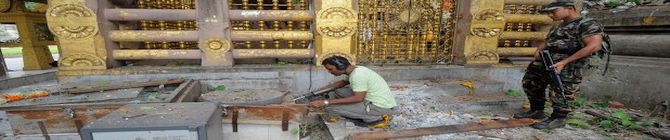
New Delhi: A special NIA court in Patna on Friday (December 17, 2021) sentenced three Jamaat-ul-Mujahideen Bangladesh (JMB) terrorists to life imprisonment and jailed five others for 10 years in connection with a blast at the Bodh Gaya temple complex in Bihar in 2018.

The eight Jamaat-ul-Mujahideen Bangladesh terrorists were convicted on December 10, the officials informed.

Paigambar Sheikh, Ahmad Ali, Nur Alam Momin have been awarded life imprisonment, while Adil Sheikh, Dilwar Hossain, Abdul Karim, Mustafizur Rahman and Arif Hussain have been awarded 10 years rigorous imprisonment.

The said case was registered on February 3, 2018, and pertains to the planting of three IEDs in and around the premises of the Bodhgaya temple complex. After investigation, charge-sheet was filed against the three accused on September 27 2018 and a supplementary charge-sheet was filed on January 28, 2019, against the remaining six accused persons.

The officials added that the further trial against one remaining charge-sheeted accused continues.


Thursday, November 25, 2021

India 'Conscious' of Bangladesh's Efforts Against Terrorism: Army Chief


New Delhi: Army Chief Gen M M Naravane has said that India was conscious of Bangladesh's efforts to deny space to terror groups that are carrying out subversive activities against India.

In a message played out during an event on Wednesday to mark 50 years of India-Bangladesh ties, he also asserted that "the historic Land Boundary Agreement" (LBA) between the two countries has shown how an issue related to border can be "resolved with mutual negotiations and a constructive outlook".

This, at a time when "certain countries" have been trying to "alter the status quo by force, and bypassing traditional rules and protocols, with complete disregard to territorial integrity of others," Army Chief Naravane said, without naming any country.

The LBA epitomises the 3Ms -- "mutual respect, mutual trust and mutual commitment -- to a rules-based order", the Indian Army chief said, and asserted that the two countries share an important strategic space in the Indian subcontinent with a land boundary spanning over 4,000 km.

Marking a new high in bilateral ties, India and Bangladesh in 2015 had sealed a historic deal to settle the old land boundary dispute through exchange of territories, removing a major irritant in bilateral ties.

During Prime Minister Narendra Modi's maiden visit to Dhaka in 2015, the two sides had swapped documents regarding the LBA that paved the way for the operationalisation of the pact signed in 1974 by the then Prime Minister Indira Gandhi and Bangladesh's founder Sheikh Mujibur Rahman to settle the border issue.

Army Chief Gen Naravane, in his recorded address at the event hosted at the IIC by Delhi-based defence think-tank Centre for Land Warfare Studies (CLAWS), also said that Bangladesh's approach to counter terrorism "resonates with India's resolve and resilience to counter terrorism in all its forms".

"We are conscious of Bangladesh's efforts to deny space to terror groups that are carrying out subversive activities against India," the Indian Army chief said.

In turn, India "continues to prevent any terror outfit" from using Indian soil to undermine the interests of Bangladesh, he said.

The event was attended by Bangladesh High Commissioner Muhammad Imran, former Army chief of Bangladesh and 1971 war veteran Lt Gen (retd) Harun-ar-Rashid, a few 1971 India-Pakistan war veterans from Indian armed forces, and a number of senior defence officials, among others.

Bangladesh and India have "come a long way in the last five decades and our friendship has stood the tests of time," Army Chief Gen Naravane said.

As neighbours, India and Bangladesh continue to grow together with shared cultures, history, opportunities and destinies, he said. The Indian Army chief also paid homage to soldiers on both sides of the border who have made supreme sacrifices, for a "brighter and more secure tomorrow".

It is the collective will of the people, standing shoulder-to-shoulder poised in the battlefield that had "turned the tide against the enemy" in the 1971 war, leading to birth of a free nation of Bangladesh, he said.

And, it is the same spirit of solidarity, camaraderie and shared destiny that "remains the cornerstone of our strong bilateral ties" even after five decades, Army Chief Gen Naravane said. India-Bangladesh friendship is a tribute to the collective will of the Bangladesh people who stood for their right to liberty, and an acknowledgement to the role of the Indian Army in the "epic struggle" that changed the lives and destinies of millions of brothers and sisters, he added.

The India Army chief later arrived at the event to launch a new book 'Bangladesh Liberation @ 50 Years: 'Bijoy' With Synergy, India-Pakistan War 1971'.


Tuesday, October 19, 2021

20 Hindu Homes Torched By Mob In Bangladesh Days After Durga Puja Violence: Reports


The attack took place late on Sunday at a village in Rangpur district’s Pirgonj upazila in Bangladesh

Amid outrage over the incidents of temple vandalism in Bangladesh, a group of assailants vandalised at least 66 homes and torched 20 homes of Hindus in the country on Sunday over an alleged blasphemous social media post.

According to local media reports, the attack took place late on Sunday at a village in Rangpur district’s Pirgonj upazila, about 255 km from the capital Dhaka.

A rumour spread in a fishermen neighbourhood that a Hindu man in the village had ‘dishonoured religion’ in a Facebook post, following which the police rushed to the spot, district’s superintendent of police Mohammad Qamruzzaman told bdnews24.com.

Even as the police stood guard around the man’s home, the attackers set fire to other homes nearby, the report said.

According to the report, the unruly crowd torched 29 residential houses, two kitchens, two barns and 20 haystacks belonging to 15 different owners in Pirgonj’s Majhipara. There were no immediate reports of casualties.

The police have arrested 52 suspects in the case while the search for other suspects is underway.

Attack On Minorities In Bangladesh

The attack on the houses of Hindus is the latest in the series of attacks on minority communities in Bangladesh.

Earlier this week, three people were killed in an attack on a Durga Puja pandal near Nanuar Dighi lake in Bangladesh's Cumilla. Violence erupted after news spread on social media that the Quran was allegedly desecrated at a Durga Puja pandal.

Following Cumilla violence, incidents of vandalism were also reported from temples in Chandpur’s Hajiganj, Chattogram’s Banshkhali and Cox’s Bazar's Pekua, the report said.

Ground reports say at least three people were killed in attacks on Durga Puja pandal in Bangladesh.

On Friday last week, at least 500-strong mob vandalised an ISKCON temple in Noakhali area and attacked devotees. One devotee One devotee was allegedly killed by the mob.

Last week, the Ministry of External Affairs (MEA) said it was in contact with the Bangladesh government and the latter have promptly reacted to ensure that the situation was under control.

Bangladesh Prime Minister Sheikh Hasina also gave a stern warning to those trying to disturb communal harmony in the country, promising action will be taken against the perpetrators of the communal violence in Cumilla.


Monday, October 18, 2021

'Send Delegation To Bangladesh': ISKCON To UN Over Attack On Devotees


We've written a letter to United Nations and appealed them to condemn this and send a delegation to Bangladesh, said Radharamn Das

Vice-President of ISKCON, Kolkata, Radharaman Das on Saturday condemned the attack on the ISKCON temple in Bangladesh and urged Prime Minister Modi to hold talks with Bangladesh Prime Minister Sheikh Hasina to end the cycle of violence.

While speaking to ANI, Radharaman Das, said, "We called PM residence and requested his secretary to inform PM that he should speak with Bangladesh PM to end this cycle of violence. Yesterday, around 500 mobs entered our temple premises and broke deities, brutally injured devotees. Two of them died.

"We've written a letter to United Nations and appealed them to condemn this and send a delegation to Bangladesh," said Radharamn Das.

On Friday, a mob allegedly attacked an ISKCON temple in Bangladesh's Noakhali district and according to the community, one of its members was killed.

"It is with great grief that we share the news of an ISKCON member, Partha Das, who was brutally killed yesterday by a mob of over 200 people.

His body was found in a pond next to the temple. We call on the Govt of Bangladesh for immediate action in this regard," the official Twitter handle of the ISKCON community said.


Sunday, October 17, 2021

Hindu Temples Attacked In Bangladesh: Anti-India Outfits Try To Dent Hasina’s Secular Credentials


Emboldened by the Taliban victory in Afghanistan, Islamist terror groups across Asia are regrouping and flexing their muscles against secular governments in the region. Bangladesh PM Sheikh Hasina has cracked down on Islamists in her country and they hate her with a vengeance. These groups have been waiting for a chance to get back at her and her Awami League party for their strong secular credentials and her pro-India foreign policy. Her government has systematically broken the back of the once-powerful Jamaat-e-Islami, which had collaborated with the Pakistani military during the Bangladesh liberation movement and committed atrocities against patriots.

The Jamaat, which wants Bangladesh to become a Muslim country where Sharia laws are enforced, was banned from participating in elections by the country’s Supreme Court in 2013. The government has held war trials against some of the Jamaat leaders involved in the massacre of innocents in 1971. At least three senior Jamaat leaders were given the death sentence in 2013. Elements of the Jamaat, along with other Islamic groups that have mushroomed in Bangladesh, are bent on removing the Awami League government and “avenge” the “injustice” done to them.

Though fractured and beaten, Islamist groups are waiting in the wings. Al Qaeda announced its arrival in South Asia a couple of years ago, and some of these elements exist in several pockets of Bangladesh. Thanks to the Taliban takeover of Afghanistan, every group now feels empowered and waits for a chance to strike back.

The communal violence in Bangladesh, triggered on Wednesday by rumours of the Holy Koran being desecrated at a Durga puja pandal in Cumilla, has to be seen in this context. Social media posts helped to fan these rumours as mobs attacked Hindu temples. So far five people have been killed, with the authorities cracking down hard on the mobs.

As is well known, riots across the subcontinent are often sparked by rumours. It is difficult to imagine any minority group in Bangladesh desecrating the Koran and that too at a puja pandal. Whether such an incident actually happened is still being investigated, but the damage has been done and idols in Hindu temples are now increasingly becoming targets of mob frenzy. Six idols of the Daniapara Kali Mandir in Munshiganj were vandalised before dawn on Saturday. The temple had no security and the idols were destroyed. Despite the tough stand of the government and its promise to bring the perpetrators to book, tension continues to simmer.

Bangladesh is one of India’s closest friends in the neighbourhood. Ever since Sheikh Hasina came to power, India-Bangladesh relations have soared. Thanks to the understanding between Delhi and Dhaka, ties remained steady even during Assam’s National Register of Citizens (NRC) exercise when large numbers of people were deemed to be “illegal immigrants” from Bangladesh. India repeatedly assured Dhaka that the NRC was an internal exercise that would not affect bilateral ties. Attacks on Hindu temples are another attempt to disrupt relations between the two neighbours by those opposed to both Sheikh Hasina and India.

New Delhi is obviously concerned about what is happening and the two countries are in touch on the issue. While India wants Bangladesh to ensure the safety of its Hindu minority and arrest those responsible for the attacks, Sheikh Hasina has asked New Delhi to make sure they is no retaliation against Bangladeshi targets in India. Although both countries realise the importance of their bilateral relations and will try to prevent any escalation, keeping zealots under control is not easy on either side of the border.

An editorial in the Daily Star published from Dhaka noted: “We do hope the Cumilla incident will be the starting point of an exception, as nothing sends a clearer message than justice—both for the victims living in fear and the perpetrators. While Bangladesh should work on its poor records in this regard, what would equally benefit us is to understand the dynamics of communal politics—the powerful forces that keep fanning communal tensions behind the scenes.”


Tuesday, September 21, 2021

Dhaka Witnesses Lone Wolf Terror Attack Weeks After Taliban Takeover


The attacker has a Japanese citizenship, sources said, adding he belonged to terror group Ansar al Islam and is now in custody.

A lone wolf terror attack was carried out in the diplomatic zone of Bangladesh capital Dhaka this week, weeks after the Taliban captured power in Kabul.

This was the first instance of a terror strike in South Asia outside Afghanistan since the Taliban takeover.

A Bangladeshi national carried out an attack near the Thai Embassy in Dhaka's posh diplomatic zone, ET has learnt. The perpetrator is being quizzed by the anti-terror unit of Bangladesh police to unearth a bigger plot, Dhaka-based sources told ET.

Last Thursday the lone wolf attacker Delawar targeted a micro bus belonging to American International University of Bangladesh near the Thai embassy injuring a few. The attacker has a Japanese citizenship, sources said, adding he belonged to terror group Ansar al Islam and is now in custody.

Ansar Al Islam also referred to as AAI is a Sunni Muslim insurgent group in Iraq and Syria. It was established in northern Iraq by former al-Qaeda members in 2001 as a Salafi Islamist movement that imposed a strict application of Sharia.

Last month, Bangladesh PM Sheikh Hasina warned radicals against attempts to encourage the Taliban ideology in the country, decrying sustained moves by pro-Pak forces to create instability.

Hasina had appealed to citizens to remain vigilant against radical ideas. “During the erstwhile BNP rule, slogans like ‘we are all Taliban and Bangla will become Afghan’ were gaining traction. The current government has countered this ideology by emphasising on the founding principles of the creation of Bangladesh,” she said during a recent interview to the state-run Bangladesh Television.


Tuesday, July 13, 2021

15 JMB Terrorists Entered India, Moved To Kashmir & Other States: Official


Kolkata: At least 15 neo Jamaat-ul- Mujahideen Bangladesh (JMB) operatives have entered West Bengal from the neighbouring country earlier this year and 10 of them moved to various parts of India including Jammu and Kashmir, an officer of Kolkata Police's Special Task Force (STF) said on Monday.

The remaining five had stayed back in West Bengal and three of them, who are Bangladeshi nationals, were arrested from south Kolkata's Haridevpur area on Sunday, the officer said.

It was revealed during interrogation of the three persons that 10 suspected JMB operatives have gone to Odisha, Bihar and Jammu and Kashmir, the IPS officer said.

The other two, who had stayed back in the state, were Sheikh Sakil and Salim Munshi, and the STF is looking for them.

'Sakil had helped them (the three others) in preparing fake Aadhaar cards which they had used to get accommodation on rent in Haridevpur. The three came to India following the instructions of senior JMB leader Al Ameen,' he said.

The three - Najiur Rahman, Rabiul Islam and Sabir -- used to sell fruits and mosquito curtains for a living.

The STF has contacted the Bangladesh Police to know details of the arrested trio, the officer said, adding that the landlord of the house of which they had taken two rooms on rent was called for questioning.

'We need to know how he came to know these persons, he said.

The National Investigation Agency (NIA) on Monday also started collecting information about the three arrested JMB operatives.

'We have started gathering information about them and trying to find out who else are associated with them. We are at a very initial stage,' an NIA officer said.

Meanwhile, when produced before a city court, the three suspected operatives of the Bangladesh-based banned outfit were remanded to 14 days' police custody.

Several documents, including jihadi materials, lists of top JMB leaders and their associates in other terror groups were seized from their possession.

A number of JMB operatives including Indians were arrested from West Bengal in the past few years.

The JMB, which carried out a terror attack at a popular café in Dhaka in 2016 in which 22 people including 17 foreigners were killed, is trying to spread its tentacles in India, the NIA had said in 2019.