Showing posts with label NSCN. Show all posts

Saturday, July 18, 2026

NSA Ajit Doval Warns Myanmar Against Anti-India Insurgency At BIMSTEC


Indian National Security Adviser Ajit Doval met Myanmar’s National Security Adviser U Tin Aung San on the sidelines of the 5th BIMSTEC National Security Chiefs’ Meeting in New Delhi. The meeting carried significant weight as India conveyed a firm message that Myanmar must not allow its territory to be used for anti-India activities.

These include cross-border insurgency, arms smuggling, and infiltration, which have long posed challenges to India’s security environment.

The talks were held against the backdrop of continuing instability in Myanmar, which has had a direct impact on India’s Northeast. Insurgent groups from the region have exploited ungoverned spaces in Myanmar to establish camps, regroup, store weapons, and launch cross-border attacks. This situation has created a persistent security concern for India, prompting the need for stronger bilateral cooperation.

The instability has also driven thousands of refugees into Mizoram and Manipur, placing immense strain on public resources and aggravating existing ethnic tensions in these states.

The influx of displaced populations has complicated local governance and heightened social pressures, making the issue not only a matter of national security but also of humanitarian management.

Weak law enforcement in Myanmar has further enabled transnational crimes to flourish. Human trafficking, arms smuggling, and narcotics trafficking from the Golden Triangle have become lucrative sources of funding for insurgent groups. These illicit activities have strengthened their operational capabilities, thereby intensifying the threat to India’s border regions.

The violence and instability have also delayed strategic connectivity projects that are central to India’s regional ambitions. The Kaladan Multi-Modal Transit Transport Project, designed to link India’s Northeast with Myanmar’s Sittwe port, has faced repeated setbacks. Similarly, the India-Myanmar-Thailand Trilateral Highway, a flagship program aimed at enhancing regional connectivity, has been hindered by the volatile security situation.

During the meeting, Ajit Doval emphasised the importance of strengthening bilateral security cooperation, improving border management, and enhancing counter-terrorism coordination. These measures are seen as essential to curbing insurgent activity and ensuring that Myanmar’s territory is not misused against India’s interests.

The dialogue at BIMSTEC reflects India’s broader strategic approach to regional security. By pressing Myanmar to act decisively against insurgent groups and transnational crime networks, India seeks to stabilise its Northeast, safeguard its connectivity projects, and reinforce its role in regional security frameworks.

The meeting underscored the urgency of coordinated action, given the complex interplay of insurgency, refugee flows, and criminal networks that continue to challenge both nations.

ANI


Tuesday, October 21, 2025

Drone Strike By India Devastates NSCN(K-YA) Camps In Myanmar’s Sagaing Region

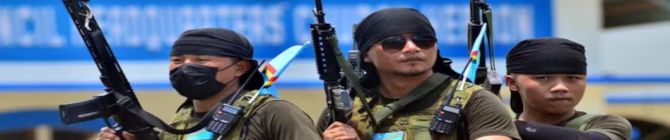
NSCN terrorists in a camp in Myanmar territory

In a major counter-insurgency operation, India carried out a precision drone strike deep inside Myanmar’s Sagaing Region, targeting terrorist camps operated jointly by the NSCN(K-YA), ULFA(I), and PLA insurgent factions. At least 8 terrorists killed including their top commander Maj Gen P Ang Mai.

The strike, conducted during the early hours of Tuesday, inflicted heavy damage and resulted in multiple casualties among senior militant cadres.

According to intelligence sources, one of the top NSCN(K-YA) commanders was killed in the attack, which specifically targeted command centres, supply depots, and weapon storage sites.

The targeted camps were reportedly being used as cross-border staging points for operations against Indian security forces in Arunachal Pradesh and Nagaland.

The drones employed in the operation are believed to have utilised precision-guided munitions, enabling minimal collateral impact while ensuring total neutralisation of high-value targets. This marks a continued evolution in India’s drone warfare capability under its modernised counter-insurgency doctrine.

Officials in New Delhi described the strike as “a calibrated and proportionate response” to recent militant attempts to disrupt peace in the North-East. The successful operation underscores India’s intent to eliminate cross-border threats through intelligence-driven and technology-led deterrence measures.

Defence and security analysts have noted that the strike serves as a strong message to insurgent groups operating from foreign soil that India’s expanding surveillance and strike reach now enables swift surgical precision beyond its borders.

Timeline of India’s Cross-Border Counter-Insurgency Strikes

2015: “Operation Hot Pursuit”

Indian Para Special Forces conducted a cross-border raid into Myanmar following the ambush of Indian soldiers in Manipur’s Chandel district. The assault destroyed multiple NSCN(K) camps and marked India’s shift toward proactive counter-insurgency operations beyond its borders.

2016–2019: Intelligence-Led Containment

During this phase, India intensified surveillance along the Indo-Myanmar border, deploying UAVs and coordinating with Myanmar’s military (Tatmadaw) for limited joint counter-insurgency expeditions. These efforts restricted militant mobility and supply chains.

2020–2022: Expansion of Drone Reconnaissance

With the induction of advanced ISR drones, India mapped insurgent hideouts across the dense jungle terrain of Sagaing and Naga Hills. This provided real-time intelligence for future precision operations.

2023: Strikes Against PLA And ULFA(I)

Reports indicated that Indian drones targeted insurgent logistics camps along the Sagaing–Tamu axis following militant incursions in Arunachal Pradesh. These actions demonstrated India’s enhanced strike capability along the eastern frontier.

2025: Current Operation In Sagaing Region

The latest drone strike signifies the most extensive use of autonomous aerial platforms along this corridor. It effectively dismantled NSCN(K-YA) and allied militant infrastructure, neutralising senior leadership and severely degrading their operational strength.

IDN (With Agency Inputs)


Tuesday, July 15, 2025

Sitting Pretty All Along Before The Massive Attack, ULFA Ultras Now Seeks New Hideouts


The United Liberation Front of Asom (Independent) (ULFA (I)) has come under significant pressure following a series of drone and missile strikes on its camps along the Indo-Myanmar border, which the group attributes to the Indian Army. 

According to multiple statements released by ULFA (I), the attacks occurred between 2 am and 4 am on Sunday, targeting their mobile camps between Longwa on the Nagaland-Myanmar border and Pangsau Pass near Arunachal Pradesh.

The group claims the strikes killed at least three senior commanders—Lieutenant General Nayan Medhi (alias Nayan Asom), Brigadier Ganesh Asom, and Colonel Pradip Asom—and injured 19 other cadres.

ULFA (I) alleges that approximately 150 bombs were dropped using drones sourced from Israel and France, marking the operation as one of the largest in recent years. The strikes reportedly hit not only ULFA (I) positions but also affected allied camps of groups such as the People's Liberation Army (PLA) and the National Socialist Council of Nagaland-Khaplang (NSCN-K).

The location of the attacks—deep in Myanmar’s Sagaing region within the Naga Self-Administered Zone—has historically functioned as a sanctuary for northeastern insurgent outfits, taking advantage of the region’s porous borders and unstable control amid Myanmar’s ongoing civil conflict.

Despite these claims, the Indian Army, Assam Chief Minister, and state police have officially denied any knowledge or participation in such cross-border operations, stating that they have "no inputs" on any such activity. Security analysts suggest that the explosion of violence in Myanmar—due to its civil war involving ethnic armed groups and a weakened central authority—makes it plausible that attacks on ULFA (I)’s camps might have originated from Myanmar’s ethnic militias or even the Myanmar military, rather than Indian forces.

The fallout from these attacks has forced ULFA (I) to seek new hideouts, given the losses and instability in their traditional bases in Myanmar. Intelligence agencies report that since being expelled from Bangladesh in 2012 and Bhutan in 2003, Myanmar had become ULFA (I)’s prime operating area. However, with the current turmoil and internal feuds among armed factions in Myanmar, the outfit finds itself navigating a hostile landscape with declining safe havens.

Amid this crisis, intelligence sources reveal that ULFA (I) chief Paresh Baruah is warming up to Bangladesh for potential new sanctuaries. Baruah is reportedly moving between Myanmar and China’s Yunnan province, attempting to re-establish connections in Bangladesh—a country that previously hosted ULFA but later cracked down on Indian separatists.

Notably, Baruah’s death sentence in Bangladesh related to the 2004 Chattogram arms smuggling case was recently commuted to life imprisonment, which may be an additional incentive for the group to look towards Bangladesh for support.

In response to the strikes and ongoing pressure, ULFA (I) has threatened retaliatory actions or sabotage activities, particularly during major observances like India’s upcoming Independence Day. Security agencies in Assam are maintaining heightened vigilance, warning that the group could attempt strikes to reassert its presence and avenge its losses.

Heavy drone and missile strikes—attributed by ULFA (I) to Indian forces but officially unconfirmed—have compelled the group to abandon key Myanmar bases and seek new refuge. The situation is compounded by the volatile security environment in Myanmar and ULFA (I)'s leadership seeking alternatives, including the possibility of re-engaging with Bangladesh for operational bases. Security agencies continue to monitor the situation closely, anticipating possible retaliatory moves by the insurgent outfit.

Agencies


Monday, July 14, 2025

How India's Kinetic Action On Myanmar Terror Groups Struck At China’s Shadow Theatre


India’s recent drone strikes on insurgent camps in Myanmar represent a significant escalation in New Delhi’s regional security posture and a direct challenge to China’s covert influence strategy in Southeast Asia.

These precision operations, reportedly involving over 100 drones, targeted key bases of the United Liberation Front of Asom-Independent (ULFA-I) and the National Socialist Council of Nagaland-Khaplang (NSCN-K) in Myanmar’s Naga Self-Administered Zone, close to the India-Myanmar border. 

The strikes are said to have killed senior ULFA-I commanders, including Nayan Asom (Nayan Medhi), Ganesh Asom, and Pradip Asom, and injured at least 19 others.

For years, insurgent groups like ULFA-I and NSCN-K have functioned as proxies for Beijing, armed through Chinese grey market networks operating out of Yunnan. These groups have been instrumental in guarding critical infrastructure linked to China’s Belt and Road Initiative (BRI), such as the Kyaukpyu–Mandalay corridor, which is vital for China’s energy and logistics supply chains to the Indian Ocean.

By providing security and logistical support—often in cooperation with Chinese private security contractors—these insurgents have helped Beijing maintain plausible deniability while exerting influence in Myanmar and across India’s north-eastern frontier.

India’s strikes have exposed and directly undermined China’s model of using non-state actors to project power and secure its interests in the region. By dismantling the leadership of ULFA-I and NSCN-K, India has disrupted a key element of China’s informal security buffer, threatening the stability of BRI-linked ventures, including mining zones and future rail projects in Myanmar. This action raises the operational costs for Chinese private security firms and jeopardises China’s ambitions to bypass the Malacca Strait for energy imports.

The strikes come at a time when Myanmar’s military junta is under severe pressure from ethnic militias and the People’s Defence Forces. The junta’s growing dissatisfaction with Chinese interference has, according to intelligence sources, nudged it closer to New Delhi, even if no official alignment has been declared. India’s actions may further encourage Myanmar to recalibrate its relationship with Beijing, given the junta’s frustration with China’s involvement in its internal affairs.

Despite widespread reports and statements from ULFA-I acknowledging the strikes and casualties, the Indian Army and government have officially denied any involvement, maintaining strategic ambiguity. This denial preserves operational secrecy and diplomatic flexibility, especially given the sensitive nature of cross-border military actions.

By targeting these camps, India has dealt a blow not only to insurgent capabilities but also to the broader Chinese security architecture in Myanmar. The destabilisation of BRI supply lines in Sagaing and the disruption of proxy networks may force China to reconsider its low-cost security model in the region, potentially making its investments more vulnerable and expensive to protect.

India’s kinetic action in Myanmar marks a turning point in the regional balance of power. It signals New Delhi’s willingness to counter Beijing’s shadow operations directly, disrupt proxy networks, and assert its strategic interests along its eastern frontier and beyond.

Based On A News18 Report


Wednesday, April 30, 2025

3 Naga Terrorists Killed In Encounter With Security Forces In Assam


Three suspected terrorists of the National Socialist Council of Nagaland (NSCN) were killed during a fierce encounter with security forces in Assam’s Dima Hasao district on Tuesday.

The operation was launched following credible intelligence that armed NSCN cadres, who had recently issued extortion notices to officials and engineers of the National Highways Authority of India (NHAI), were hiding in areas under the Haflong police station.

The joint search operation, conducted by Assam Police Special Units and Assam Rifles, began on Saturday evening and lasted nearly 60 hours. On Monday, security forces encountered the armed group in the forested area between N Kubin and Hera Kilo. The terrorists opened fire, prompting the security forces to retaliate, resulting in a heavy exchange of gunfire that lasted several hours.

After the gunfight, the bodies of three terrorists were recovered from the dense forest. Authorities also seized two AK-series rifles, a pistol, and a cache of ammunition from the site. The exact faction of the NSCN to which the deceased terrorists belonged has not yet been officially confirmed, though reports have suggested possible links to the NSCN-IM faction.

This incident occurred just days after another major encounter on April 27 in Arunachal Pradesh’s Longding district, where three terrorists of the NSCN-K-YA faction were killed during a joint operation by the Indian Army and Assam Rifles. That operation was launched after two construction workers were kidnapped in the area, leading to a rescue and the recovery of weapons and other war-like materials.

Authorities have noted that, despite ceasefire agreements with the Nagaland government, NSCN factions continue to engage in extortion, abduction, and violence in neighbouring Assam’s Dima Hasao district. The search operation in Dima Hasao remains ongoing as security forces continue their efforts to ensure peace in the region.

Agencies


Friday, September 13, 2024

NSCN (IM) Cadre Held In Tinsukia; Massive Cache of Arms, Ammunition Seized


Digboi: After an intense three-hour search operation, security forces successfully apprehended a cadre of the National Socialist Council of Nagaland (NSCN) - Isak Muivah (IM) faction, in Assam's Tinsukia district on Thursday.

The arrested individual, identified as Rangassor Chakma, 28, a resident of Devapuri Village in Arunachal Pradesh, was found in possession of a substantial cache of ammunition.

Acting on a tip-off about the presence of five NSCN (IM) cadres in Inthem village, a joint operation was launched by the Assam Police and the 6 Sikh Regiment, led by SDPO Margherita IPS Shambhavi Mishra.

The intense search, which began during the intervening night of Wednesday, culminated in Chakma's arrest around 8:30 am on Thursday.

During interrogation, Chakma admitted his affiliation with the NSCN (IM) and disclosed the location of a hidden arms cache in the surrounding jungle.

The recovered arms and ammunition included two pistols with magazines, three hand grenades, and various rounds of ammunition, including 19 rounds of 5.56 mm, 10 rounds of 9 mm, 10 rounds of 7.62 mm, and six rounds of .22 mm, as well as a 5.56 mm magazine.

This operation follows a series of recent successful actions against the NSCN (IM) in Tinsukia.

In July, the Indian Army and Assam Police thwarted a major extortion network linked to the group, arresting five individuals involved in funnelling extortion funds. Additionally, earlier this month, security forces prevented four youths from joining the NSCN (IM) during a recruitment bid.

The ongoing efforts by the Indian Army and Assam Police continue to target and dismantle the militant group’s activities in the region, aiming to curb their influence and operations.

Agencies


Monday, March 25, 2024

Assam Rifles Apprehend NSCN-KYA Terrorist From Nagaland


Meregkong: Assam Rifles apprehended one cadre belonging to the insurgent group, National Socialist Council of Nagaland (Khaplang Yung Aung) in the general area of Merangkong, Nagaland, officials said on Monday.

According to a press release from HQ IGAR (N), the apprehended individual and the recovered weapon have been handed over to the police.

The operation was conducted on March 23.

"Acting on specific intelligence regarding the presence of a cadre in the general area of Merangkong, Nagaland, Assam Rifles launched a special operation on March 23, 2024 and apprehended one cadre of the NSCN-KYA Group," the statement added.

The individual was in possession of one single-barrel country-made gun, it said.

This report is auto-generated from a syndicated feed


Sunday, December 31, 2023

Three Naga Groups Come Together For Talks With Centre For Solution To Decades-Old Naga Political Issue

Women wing of Naga terrorists

The Nagas are divided on the twin contentious demands of flag and constitution. The Nagas are one of Manipur's three major communities

DIMAPUR: Three Naga groups have come together and decided to pursue negotiations for a solution to the decades-old Naga Political Issue with the Centre jointly.

The decision was taken on Saturday during a meeting attended by leaders of the three groups -- National Socialist Council of Nagaland (NSCN) led by Akato Chophy, NSCN led by Khango and Naga National Council (NNC) led by Z Royim.

All three are splinter groups.

"The three groups have come together to have a joint political venture in 2024," said Akato, while addressing journalists after the meeting here in the presence of leaders of the other two groups.

Asked if they have already approached the Centre with their decision to hold a dialogue, he said, "We have made separate approaches in the past but now we will make a joint effort on the Naga issue."

Akato also affirmed that they would be holding a dialogue separate from the negotiations being held by the Working Committee of Naga National Political Groups (WC-NNPGs) with the Centre.

The NNPG is composed of only seven groups while other Naga groups have been left out, he said, announcing that the three groups welcome like-minded organisations to join them for the cause of Nagas.

Stating that there is no nomenclature for the three groups who have come together, Akato said they will approach the Centre for political talks.

The Naga Political Issue is considered the longest-running insurgency in the country.

The Centre has been holding separate negotiations with NSCN-IM since 1997 and the WC NNPGs since 2017.

Eight years have passed since the signing of the acclaimed Framework Agreement on August 3, 2015 with NSCN-IM and another six years have gone by following the inking of Agreed Position on November 17, 2017 with WC NNPGs.

The NSCN-IM has remained adamant on its demand for a separate flag and constitution for the Nagas as well as integration of Naga-inhabited areas spread over four states of India -- Arunachal Pradesh, Assam, Manipur and Nagaland, and also Myanmar.

On the other hand, the WC of NNPGs has expressed its willingness to accept whatever is granted for now and continue with the talks.

Nonetheless, as of now, there is no significant development in the political negotiations between the Centre and the Naga groups.


Saturday, March 25, 2023

AFPSA Extended In Parts of Arunachal, Nagaland


New Delhi: The Central government has extended for six months the "disturbed area" status of parts of Arunachal and Nagaland under the Armed Forces (Special Powers) Act, 1958.

The Union Ministry of Home Affairs (MHA) on Friday in two separate notifications stated that the decisions have been taken after reviewing the law and order situation in both the states.

The AFSPA empowers security forces to arrest a person without a warrant and enter or search premises without a warrant along with some other actions.

The MHA notification dated March 24 stated that AFPSA has been extended in the districts of Tirap, Changlang and Longding from April 1 to September 30.

In addition, the Government of India has also extended AFSPA in the areas falling within the jurisdiction of Namsai, Mahadevpur and Chowkham police stations in the Namsai district of Arunachal Pradesh, bordering the state of Assam.

Earlier, the Central Government in the exercise of the powers conferred by Section 3 of the Armed Forces (Special Powers) Act, 1958 (28 of 1958) had declared Tirap, Changlang and Longding districts in Arunachal Pradesh and the areas falling within the jurisdiction of Namsai and Mahadevpur police stations in Namsai district of Arunachal Pradesh, bordering the State of Assam, as 'disturbed area' for six months from April 1 to September 30, 2022, unless withdrawn earlier.

The MHA notification also stated that the AFSPA has also been extended in eight districts and 21 police station areas falling under five other districts of Nagaland after declaring them as "disturbed areas" for a period of six months with effect from April 1 to September 30 this year, unless withdrawn earlier.

AFSPA has been extended in Dimapur, Niuland, Chumoukedima, Mon, Kiphire, Noklak, Phek, and Peren districts of Nagaland for the next six months.

Besides, the AFSPA has been extended in the areas falling within the jurisdiction of 21 police stations in five districts of Nagaland-- six police stations each in Zunheboto and Mokokchung districts; five police stations in Kohima; three police stations in Wokha; and Yanglok police station in Longleng district.

Earlier, the Central Government in the exercise of the powers conferred by Section 3 of the Armed Forces (Special Powers) Act, 1958 (28 of 1958) had declared nine districts and 16 Police Stations in four other districts of Nagaland as 'disturbed area' for a period of six months with effect from October 1, 2022, to September 30, 2022.


Wednesday, March 8, 2023

NSCN Terror Group Demands Release of All Naga Political Prisoners Held Hostage In India And Myanmar


The National Socialist Council of Nagaland has demanded the government of India and Myanmar immediately release all Naga Political Prisoners of War (NPPoW)

In a press release, the NSCN stated that the political conflict between India, Nagalim, and Myanmar has lasted more than seven decades, making it one of modern history's oldest international conflicts.

The NSCN also alleged that were no official or informal treaties between the Naga people and the British during the colonial British Empire's occupation of the Free Naga country.

"Similarly, on August 14, 1947, as the British were about to leave the region, the Nagas declared independence. Under these conditions, all countries' sovereignty must be respected. International law, including the purposes and principles of the United Nations Charter, must be strictly followed," the release added.

The occupying forces, India, and Myanmar must recognize that all countries, large or small, powerful, or weak, rich or poor, are equal members of the international community.

The perspectives of India and Myanmar shaped how the international community viewed the conflict; however, for the Nagas, we are defending our own country against forces that are purely an invasion and illegal occupation by India and Myanmar after the colonial British Empire left the Naga homeland.

While India and Myanmar illegally occupied Naga country, they also systematically framed the conflict as an internal issue, viewing the Nagas defending their own country as a security threat to their respective countries. The conflict has resulted in the detention of numerous Nagas by the respective governments, many of whom have been labelled as "insurgents", "terrorists", or arrested under "terror funding". Mrs. Alemla Jamir, a cabinet minister in the National Socialist Council of Nagalim/Government of the People's Republic of Nagalim/(NSCN/GPRN), for example, was detained by India on December 17, 2019, at Domestic Airport (T-1) in New Delhi and later arrested in a "terror funding case" and remains in Indian custody.

The self -styled government of the the People's Republic of Nagalim also raised a series of question for India and the international community are and asked if the NSCN/GPRN is a terrorist organization.

"We urge the international community to uphold and defend international fairness and justice, to promote an equal and uniform application of international law, and to reject double standards. We oppose the occupation of Nagalim, and the international community must immediately call India and Myanmar's illegal occupation into question," the release stated.

The NSCN also said that the international community should remain committed to the right approach of promoting peace talks, assisting India, Nagalim, and Myanmar in the conflict, and creating conditions and platforms for the three entities to resume negotiations or call for an immediate withdrawal of occupying forces from Nagalim.


Sunday, January 29, 2023

Assam Rifles, NSCN(IM) Terrorists Engage In Minor Confrontation In Nagaland


Peren: A team of Assam Rifles and a group of NSCN (IM) cadres engaged in a "minor confrontation" in Intanki National Park in Nagaland, said Indian Army sources on Sunday.

As per sources, multiple domination patrols of Assam Rifles were out for durations varying from 72-96 hours in the run-up to Republic Day.

"Multiple domination patrols of Assam Rifles were out for durations varying from 72-96 hours in the run-up to Republic Day. One such patrol while returning after completing assigned task took an administrative break at Intanki National Park at 4 PM on January 27," said the Indian Army sources.

"During the break, the patrol party observed NSCN (IM) cadres moving on the same route and the two parties had a minor confrontation," the sources said.

The sources further said that the Assam Rifles ensured that the incident did not escalate and the Assam Rifle patrol leader took the decision to disengage his troops.

Meanwhile, in a joint operation, Assam Rifles and police apprehended two militants of the National Socialist Council of Nagaland (NSCN-K(YA) and recovered a huge cache of arms and ammunition in Arunachal Pradesh's Changlang district.

Security forces recovered one Chinese-made 7.62 mm rifle, two AK magazines, 490 rounds of ammunition of AK-47 rifle, one pistol with magazine, two rounds of pistol ammunition, 10-12 meters' safety fuse, one radio set, two mobile phones, two batteries from the jungle area of Old Longchong in Rima Putak circle in Changlang district.

Mihin Gambo, Superintendent of Police of Changlang district told ANI that, based on intelligence input regarding the presence of NSCN-K (YA) militants in the general area of Khamkai and Namgoi in Nampong circle, 19th Assam Rifles and Arunachal Pradesh police launched a joint operation in the area on January 28 night.

"During the operation, security personnel apprehended two NSCN-K(YA) militants from the area and they were identified as Nayan Kumar Chakma and Gangwang Wanglee," Mihin Gambo said.

The officials further said that, based on the revelation of Nayan Kumar Chakma, security personnel recovered a huge cache of arms and ammunition from the jungle area of Old Longchong in Rima Putak circle.

On the other hand, one NSCN-K(YA) militant identified as Kamtim Rekhung on January 26 had surrendered before Changlang district police, Assam Rifles and CRPF.


Wednesday, November 2, 2022

Nagas Should Join Hands & Support Negotiating Groups For An Early Political Solution: CM Zeliang


Kohima: Former Nagaland Chief Minister T R Zeliang has urged the Naga people to join hands and support the negotiating groups to bring the Naga Political issue to a logical conclusion at the earliest as this is the finest time for a solution.

Zeliang, who is currently the chairman of United Democratic Alliance (UDA) said this while addressing a press conference in Chumoukedima on Monday.

“At present, all the Naga negotiating groups have come together and all 60 MLAs are also together with one voice for the sake of Naga solution. So why not we all join hands and support both the negotiating groups to arrive at a logical conclusion at the earliest instead of pointing fingers at each other with political vendetta for personal vested interest,” said Zeliang.

Maintaining that the political talks between the Government of India (GoI) and NSCN (IM) are positively progressing, he said “we expect a solution sooner than later, so let us hope that GoI will bring out the common draft so that before inking the accord, it can be brought to the Naga leaders, and all concerned to also see and acknowledge if it is acceptable to us.” By any standard, Zeliang said, the negotiation is long enough, and it must have a logical conclusion.

Some principal issues which are being deliberated upon and yet to arrive at a conclusion, need to be resolved amicably at the earliest, he said.

Zeliang said that the core committee of the state government on Naga Political Issue was informed that some competency points are transitional towards a final settlement.

“With such a solution formulation process, we can keep moving forward to reach the final agreement as stated by the Prime Minister,” he said.

For the last many decades, no Prime Minister or Home Minister has come up in this manner with such a positive attitude to solve the Naga Political issue, he said, while strongly maintaining that this is the finest opportunity for both parties, the GoI and the Nagas to finally resolve the long-protracted Naga Political Issue.

“If we miss this opportunity, I am doubtful that we will be able to maintain this momentum again in the coming years and also for any Indian leader to revisit this chapter with such vigour and concern to solve the Naga Political Issue,” said Zeliang.

The Government of India (GoI) has been holding parallel peace parleys with NSCN-IM and the Working Committee of Naga National Political Groups (WC, NNPGs) comprising at least seven Naga groups.

The talks with NSCN-IM started in 1997 following the signing of a ceasefire agreement and they inked the Framework Agreement on August 3, 2015.

While the WC NNPGs started separate negotiations in 2017 and signed the Agreed Position in November same year, have expressed their willingness to go ahead with a solution with whatever is possible now and continue discussing the remaining issues post solution.


Wednesday, September 21, 2022

Naga Peace Talks: Centre, NSCN-IM Dialogue Resumes In Delhi


On Monday, the NSCN-IM team travelled from Nagaland's Dimapur to Delhi

A seven-member envoy from the National Socialist Council of Nagalim (NSCN-IMIsak-Muivah )'s group, led by the collective leadership representatives, is scheduled to meet with Union home ministry officials in New Delhi on Tuesday to try to resolve obstacles in Naga peace negotiations.

The meeting may possibly include AK Mishra, the Centre's envoy for the Naga peace negotiations. On Monday, the NSCN-IM team travelled from Nagaland's Dimapur to Delhi.

Since May, talks between the Centre and the National Socialist Council of Nagalim-Isak Muivah (NSCN-IM) have halted.

On Saturday, members of the core committee and delegates from the NSCN-IM met for two hours in Chumoukedima.

The conference was called after the Centre ordered the core panel, led by Chief Minister Neiphiu Rio, to persuade the organisation to continue peace negotiations and reach a final agreement, PTI reported.

Since 1997, the union government has held two different talks with the NSCN(IM) and the Naga National Political Groups (NNPGs), which include seven organisations.

On August 3, 2015, the Centre inked a framework agreement with the NSCN(IM), and in December 2017, it reached an agreement with NNPGs.

“They are not happy with interlocutor A K Mishra over the omission of some of the politically important points, which were included in the formulation paper submitted by former interlocutor NN Ravi," Nagaland’s United Democratic Alliance Chairman T R Zeliang was quoted by PTI in its report.

According to the UDA chairman, the NSCN-IM notified the core committee that it would begin peace negotiations provided "it is based on the framework agreement and formulation documents submitted by Ravi and the Centre's current interlocutor A K Mishra."

The core committee's function as a facilitator, according to Zeliang, remains unaltered.

“Things are working out and we hope that the talks will resume very soon,” he said.

Rh Raising, a member of the NSCN-IM leadership, informed reporters that the organization's team will soon depart for Delhi to begin talks with the government.

The framework deal negotiated by the Centre and the NSCN-IM occurred after more than 80 rounds of discussions since a ceasefire accord was inked in 1997, following decades of insurgency in Nagaland, which began shortly after independence in 1947.

However, the ultimate solution has yet to be implemented.

The NSCN-insistence IM's on a distinct flag and constitution for the Nagas has caused a delay in reaching a definitive agreement.


Sunday, August 28, 2022

'One People, One Nation': NSCN-IM's Mega Meet In Dimapur


Kohima: Thousands of cadres belonging to National Socialist Council of Nagalim (Isak-Muivah) led by their leaders on Friday held a mega assembly to reiterate their demand for an ‘One people, one nation’, the Naga outfit sources said.

The NSCN-IM in a statement said that it was a “historic moment” on Friday when nearly 7,000 Naga national workers from 16 regions of Nagaland, gathered at Agri Expo in Dimapur, under the agenda, “Reaffirming of One people, one nation”.

“This coordination meeting of the Naga national workers from Nagaland was necessitated as many divisive elements and groups are ‘mouth-louding’ for Naga solution only for Nagaland state and ready to forego the Naga National Flag and Constitution in the name of Naga solution,” it said.

The Naga group said that this is tantamount to selling out the Naga national identity “as stoutly defended by our forefathers”.

Significantly, this is against the national principle of “one people one nation” that was laid down by our great Naga freedom fighters, they said.

The NSCN-IM said that “in the background of this treacherous turn of development, Naga national workers from Nagaland were compelled to deliberate on the situation in order to save the Naga nation”.

The statement mentioned that NSCN Chairman Ino. Q. Tuccu in his speech said: “Nagas are one wherever they are, one common goal, one issue.”

He also made a pointed response to the cry of the public for the delay of the Naga solution. “We cannot give away our rights for the sake of the Naga solution and we can never compromise the Nagas’ rights.”

The Naga groups as part of their pressure tactics hoisted the “Naga national flag” and held a large number of programs in Nagaland and in many villages in the Naga dominated areas of Manipur to celebrate the “Naga Independence Day” on August 14, a day before India’s Independence Day.

The Naga groups dominated by the NSCN-IM, celebrating the August 14 events in a big way once again demonstrated that there would be no solution to the Naga issue without a separate flag and Constitution.

Since 1997, the government has held more than 85 rounds of negotiations with the NSCN-IM and other Naga groups.

However, the NSCN-IM’s insistence on a separate Naga flag and Constitution have become big hurdles.

The former government interlocutor and then Nagaland Governor R.N. Ravi, who is now holding the gubernatorial post in Tamil Nadu, had rejected these demands on a number of occasions.


Thursday, August 11, 2022

Ahead of Independence Day, ULFA-I, NSCN-K Terrorists Attack 3 Army Camps Bordering Myanmar; Security Forces Launch Massive Ops


ULFA-I and NSCN-K have asked people in Assam, Nagaland, Manipur, Tripura and Meghalaya not to take part in any activities related to Independence Day

Ahead of 75th Independence Day celebrations, two banned rebel groups attacked three Indian Army camps in Arunachal Pradesh and Nagaland bordering Myanmar on early hour of Tuesday. Paresh Baruah-led United Liberation Front of Assam- Independent (ULFA-I) and Yung Aung led-National Socialist Council of Nagalim- Khaplang (NSCN-K) attacked the Army camps with mortar, rocket launcher, granad and sophisticated arms.

Sources said ULFA-I and NSCN-K militants attacked on a newly built Army camp at Pangsu pass in Arunachal Pradesh near India-Myanmar border. They claimed that the guerrilla team attacked the army camp with mortars and rocket launchers in which a junior commission officer (JCO) of the Army was injured. The second attack took place in Saramati area and third was in Noklak area bordering Myanmar. The joint rebel group attacked on 14th Assam Rifles camp in Noklak area, which was just a firing incident and no casualties were reported. All attacks were carried out by the rebel groups around 3 AM.

In a press release issued by PRO (Defence) Lt Col AS Walia said, “Incident of firing on Assam Rifles troops by militant groups from across the Indo-Myanmar Border took place early morning today in general area of Tirap Changlang. Assam Rifles troop were undertaking enhanced patrolling activities in view of heightened vigil for the forthcoming Independence Day. One JCO sustained minor injury in hand. No injury or any other damage reported. Enhanced surveillance by own troops to continue.”

Confirming the incident, Changlang district Superintendent of Police (SP) Mihin Gambo said firing was reported from the Pangsau Pass area this morning. “It is immediately not known which insurgent groups were involved in the attack,” SP Gambo said.

On August 6, the ULFA-I and Yung Aung faction of the NSCN-K called for a shutdown in five states including Assam, Nagaland, Manipur, Tripura and Meghalaya on the Independence Day terming it “fake” celebrations. They declared the shutdown from 12 am till 6 pm on August 15.

Security has been beefed up, particularly along India-Myanmar borders in view of the militants’ call for boycott. Last year, the outfit had decided not to call for a boycott of the event—for the first time since 1996. The latest decision could act as a hurdle in efforts to bring ULFA-I to the negotiation table for peace talks.

In the statement issued on Saturday, both ULFA-I and NSCN-K asked people in Assam, Nagaland, Manipur, Tripura and Meghalaya not to take part in any activities related to Independence Day.

The statement mentioned that the shutdown would be from midnight of August 14 and continue till 6 pm the next day. However, “emergency departments, media and religious activities” would be exempted.

Mentioning a decline in standards of living of people and a slowdown of the economy following the Covid-19 pandemic, the outfits said Independence Day should not be celebrated. Last year, for the first time in its 42 years old history, ULFA-I had not boycotted Independence Day celebrations or called for a ‘bandh’ to mark the occasion.

“In view of the COVID-19 situation….and other problems like flood, erosion and unemployment affecting indigenous populations, ULFA-I has refrained itself this time from armed protest of the fake Independence Day of colonial India or called for a ‘bandh’,” the statement, issued by the outfit last year.

Since its inception in 1979 with the aim of an armed struggle to create an independent Assam, ULFA-I has been boycotting Independence Day and Republic Day celebrations and indulged in violent activities on those days.

Since May 2021, when the Bharatiya Janata Party-led government assumed office in Assam for the second time, there has been speculation that ULFA-I could join peace talks with the Centre. Assam chief minister Himanta Biswa Sarma had indicated on occasions that back channel discussions were underway with regard to the issue.

Meanwhile, security forces have launched a massive operation near Indo-Myanmar border. Pangsu Pass area is one of the remotest area in Arunachal Pradesh and shares boundary with Myanmar. Most of the insurgent groups of northeast have set up their camps in the jungles of Myanmar and very easily they penetrate in Arunachal Pradesh through jungle routes.


Friday, July 29, 2022

14 NSCN Terrorists Drop Arms In Arunachal Pradesh


The concerted efforts, relentless pursuit and human approach of Longding police at grassroots levels under the Operation Mainstream initiative to convince the insurgents to come over ground and join the mainstream have paid well as this is the highest simultaneous surrender in history of TCL. The surrendered cadres were engaged in extortion and collection of taxes

Earlier, important insurgent leaders have shunned the insurgent groups and have joined the mainstream giving a blow to the underground outfits.

The outfits revealed about their hard life in the organization and appealed their fellow cadres who are still in the NSCN-IM, KYA, R, U, KK to give up violence and start a new beginning by surrendering

In a landmark boost to peace and tranquillity in the Northeast India, 14 National Socialist Council of Nagaland (NSCN) terrorists have dropped arms and surrendered before the police administration in Arunachal Pradesh. The surrender was made before the Superintendent of Police Longding on Thursday, 28 July.

The concerted efforts, relentless pursuit and human approach of Longding police at grassroots levels under the Operation Mainstream initiative to convince the insurgents to come over ground and join the mainstream have paid well as this is the highest simultaneous surrender in history of TCL.

The surrendered cadres were engaged in extortion and collection of taxes. They were all holding influential positions and had been working actively for the outfit. Among the 14 surrendered, 2 are from NSCN KYA, 10 from NSCN IM, 1 from ENNG and 1 from NSCN U.

Earlier, important insurgent leaders have shunned the insurgent groups and have joined the mainstream giving a blow to the underground outfits. This is owing to the persistent efforts by security forces to bring peace and tranquillity in the region by convincing the underground elements to give up arms, thereby taking the path of stability and prosperity in the region.

The outfits revealed about their hard life in the organization and appealed their fellow cadres who are still in the NSCN-IM, KYA, R, U, KK to give up violence and start a new beginning by surrendering before the police and administration as they said they have understood that life of UG apart from being an anti-national act, is wastage of their precious life.


Sunday, May 1, 2022

Terror Outfit Kangeleipak Communist Party Shifted To Delhi 6 Years Ago To Conduct Subversive Terror Activities: Nia


New Delhi: Proscribed terrorist organization Kangeleipak Communist Party (KCP) shifted to Delhi six years ago to plan and carry out subversive terror activities, National Investigation Agency (NIA) officials said.

According to officials, the outfit was involved in hatching a conspiracy for raising funds by terrorizing and committing extortion from local persons and government officials in Manipur.

The anti-terror agency said the outfit appointed three of its members, including a woman, and they managed to procure hand grenades, pistols, and live cartridges in Manipur.

These terrorists identified as Khoirom Ranjit Singh, Pukhrihongbam Prem Kumar Meitai, and Irungbam Sanatombi Devi-- in furtherance of their conspiracy, "shifted to Delhi to plan and carry out subversive terror activities", said officials.

Initially, the Special Cell of Delhi Police had registered the case soon after getting inputs about the terror activity belonging to the proscribed terrorist organization Kangeleipak Communist Party (KCP) on January 12, 2017.

The case was later taken over by the National Investigation Agency (NIA) on March 16, 2017.

The fact was revealed as a special court here in the national capital on Friday sentenced three Manipur-based terrorists--Khoirom Ranjit Singh, Pukhrihongbam Prem Kumar Meitai, and Irungbam Sanatombi Devi -- in the case of Kangeleipak Communist Party (KCP).

Singh and Meitai were sentenced to seven years of rigorous imprisonment and a fine of Rs 39,000 each. However, Devi was convicted to five years of rigorous imprisonment and with a fine of Rs 21,000.

All three are charged under section 120B (criminal conspiracy) of the Indian Penal Code, sections 17, 18B, 20, 20, 38, 40 of the Unlawful Activities (Prevention) Act and Explosives Substances Act.

After investigation, three charge sheets were filed on July 10, 2017, May 24, 2018, and December 28, 2018, against five accused persons.

Kangleipak Communist Party is among the banned terrorist organisations under the Unlawful Activities (Prevention) Act, 1967. The group Kangleipak is engaged in armed struggle in Manipur since 1980.

Kangleipak Communist Party was formed on April 13, 1980, under the leadership of Y. Ibohanbi. Although the group is ostensibly Communist, named after the historical name of Manipur, Kangleipak, it is more concerned with the preservation of Meitei culture and demands secession of Manipur from India.

Founder of the Kangleipak Communist Party, Y. Ibohanbi, was killed during a security force operation in 1995. Subsequently, the Kangleipak Communist Party split into several factions such as the ones headed by City Meitei (KCP- City Meitei), Prithvi (KCP-P), Mangang (KCP-M), and Noyon (KCP-N).

On May 30, 2005, four front-ranking KCP cadres, including Moirangthem Boicha alias Prithvi, chief of the KCP-P, and his wife Ibemcha Devi were killed during an encounter with the security forces (SFs) at Nongada Makha Leikai in the Imphal East district.

Following a decision taken during a five-day central committee meeting held during May 4-8, 2006, the Kangleipak Communist Party factions are reported to have merged together.


Tuesday, April 5, 2022

Naga Separatist Leader Muivah Says Centre Going Back On Its Word


Muivah raised the “Naga political issue” at the recent general assembly of Unrepresented Nations and Peoples Organization (UNPO) in Washington DC

GUWAHATI: As the deadlock in Naga talks continues, separatist leader and general secretary of the National Socialist Council of Nagalim (NSCN-IM), Thuingaleng Muivah accused the Centre of misinterpreting what had been mutually agreed upon and going back on its word.

Raising the “Naga political issue” at Washington DC at the March 26-27 general assembly of Unrepresented Nations and Peoples Organization (UNPO), Muivah said (His speech was shared with the media by his outfit) after 22 years of intensive negotiations involving six Prime Ministers, the historic Framework Agreement was signed between the Government of India and NSCN-IM on August 3, 2015.

He said the government of India had recognized the unique history and situation of the Nagas after acknowledging historical facts.

He explained that unique history meant the Nagas have a history of independence while unique situation meant the situation in Nagalim was aggression on Nagalim, not a law and order situation in India. He said that based on the universal principle of democracy, the two parties reiterated that ‘sovereignty lies with the people.’ Muivah explained that it meant sovereignty of the Nagas lay with the Nagas and vice-versa.

“…It is further stated that Nagas and Indians will coexist as two entities sharing sovereign power which will be defined in the competencies. By coexistence of the two entities, it means Nagas will not merge with the Union of India, but they will coexist with India maintaining their national entity,” a statement issued by the NSCN-IM quoted Muivah as saying.

The rebel leader said in the competencies, that the government of India recognized the territories of the Nagas stating that the land and the natural and mineral resources belonged to the Nagas.

The government of India also recognized the Nagas’ legitimate right of territorial integration of all Naga areas under one political roof. Since the unique history of the Nagas and the sovereign right of the Nagas are recognized, it is understood that the Naga flag and constitution are ingredients of their sovereignty, he said.

“In spite of all these facts, commitments and agreements, the government of India has started misinterpreting what has been mutually agreed upon and going back on its word. In the event of breaking down of the current negotiations, we foresee serious human rights violations again in Nagalim,” the insurgent leader said.

Muivah also briefed the house of the Naga resistance movement which had culminated in the signing of Framework Agreement. He said the case of the Nagas was an invasion of Nagalim by India and Myanmar. The Nagas have been living in their own free country till the British imperialist forces occupied a part of it in 1832 while the rest called the free Naga area remains as free as ever, he said.

“In 1950, the Indian Constituent Assembly invited the Nagas to join the Union of India, but it was rejected by the Naga people. The Nagas have neither been a part of the Union of India nor that of Burma either by consent or by conquest,” Muivah said.

He said to continue with its military occupation of Nagalim and subjugate the Nagas, the government of India had imposed its will upon the Nagas in the form of the 16-point agreement in 1960 (it led to Nagaland’s creation as a state) and the Shillong Accord of 1975 but the Nagas rejected both.

“Realizing that seeking a military solution to the political problem is a futile exercise, the government of India invited the NSCN leadership for political talks. Thus, a ceasefire agreement was signed and declared on August 1, 1997,” Muivah added.


Sunday, January 23, 2022

Why India Is Worried About China And Myanmar As Conflict Flares Up In Its Northeast Region: Chinese Media


Trouble has returned to India’s remote northeast bordering Myanmar, a region with historically testy ties with New Delhi. India fears Myanmar could offer a safe haven for insurgents to regroup, as it also harbours suspicions rival China could be backing separatist groups

Trouble has returned to India’s remote northeast, a region that has long had a testy relationship with New Delhi. The area spans seven states, including four that share a border with Myanmar and one with China.

More than 200 ethnic groups and tribes live across the resource-rich region, where several insurgents and separatist movements operate.

Many of these separatist groups claim the Indian government has done little to help their communities since independence, but exploits them of their assets, from rare herbs in Assam to metals like copper in Sikkim and gold in Nagaland.

In recent months, the northeast has been rocked by fresh violence and protests against Prime Minister Narendra Modi’s administration. These have been complicated by unrest in Myanmar against a military coup that toppled the elected government in February 2021.

At the same time, China’s growing engagement with Myanmar, its assertiveness in the Asia-Pacific and its ongoing border stand-off with India have also rattled New Delhi.

Why have clashes erupted in India’s northeast?

Since the latter half of 2021, a series of separate events fuelled by historical tensions and territorial feuds have shattered the uneasy peace in India’s northeast.

In August, decades-old border disagreements between the states of Assam and Mizoram were reignited after massive crowds from both sides clashed at a contested spot, killing at least six police officers and injuring more than 50 people.

In November, militants in Manipur state linked to the separatist People’s Liberation of Army of Manipur ambushed a convoy consisting of personnel from the Indian paramilitary force, the Assam Rifles, killing seven of them, including the commanding officer’s wife and son.

In December, eight civilians in Nagaland state were killed after Indian soldiers attacked a pickup truck, mistakenly believing it to be ferrying insurgents. The shooting sparked a violent protest that led to the deaths of six more civilians and one soldier, and injured many others.

As anger over the Nagaland killings continues to simmer, civil society organisations have demanded that the Indian armed forces prosecute every soldier involved in the December incident and that all army camps in the Mon district, where the incident occurred, be moved out of civilian areas.

On January 15, multiple representatives from the Konyak community – Nagaland’s largest tribe – held a summit to discuss a response towards the bloodshed.

“We decided to give the government 10 more days for them to ensure justice for those dead. If they don’t, then we will escalate our movement,” said Phoe Konyak, the general secretary of the Konyak Students Union (KSU).

While the KSU secretary refused to elaborate on the next steps, a statement by various civil society organisations, including the KSU, warned they would “continue the non-cooperation” with the Indian army and “abstain” from participating in any government-organised events held in the area, if there was no action taken by January 25.

Participants at the summit also announced that a “Genocide Park” memorial would be built at the spot of the clashes.

Meanwhile, there are fears a 2015 peace deal signed between the Modi government and the separatist Nationalist Socialist Council of Nagaland, which has yet to be fully implemented, will be scuppered.

What Is The Armed Forces Special Powers Act?

While India’s Union Home Minister Amit Shah expressed regret and blamed the Nagaland killing on “mistaken identity”, it has triggered fresh upheaval in the state, with its ramifications being felt across the northeast.

Anti-government protests have spread in the region, with locals demanding that New Delhi repeal the Armed Forces Special Powers Act (AFSPA), a controversial colonial-era law that gives sweeping powers to the Indian army – including the power to shoot suspects and the ability to make arrests without warrants – in any area the government declares to be “disturbed”. The legislation also protects officials from any legal proceedings against them.

The demand is being echoed by even local government figures linked to the ruling party, including Meghalaya’s chief minister Conrad Sangma, whose party is in alliance with Modi’s Bharatiya Janata Party.

But many within the Indian army say that repealing AFSPA would affect military and paramilitary forces engaged in counter-insurgency operations. Already, the Assam Rifles has been forced to “temporarily” suspend its operations in Mon district, even though the district is a sensitive border-district along the India-Myanmar boundary.

Amid these woes, the Modi government is also dealing with a vexed question around the influx of refugees from neighbouring Myanmar.

How Is Myanmar Tied To All This?

India and Myanmar share a 1,643km-long porous border, where the Indian states of Arunachal Pradesh, Nagaland, Manipur and Mizoram lie. Many tribes in the area have close ties across the border. Hence, local Indian populations have been sympathetic to refugees fleeing from the Myanmar coup.

Unwilling to be seen siding with those opposing the Myanmar junta, the Indian government has cautioned the four states against taking in refugees, except only those in dire circumstances. But locals have strongly protested the order, which has become an emotive issue for communities along the border. In addition, New Delhi might have reasons to fear that the coup has distracted Naypyidaw from taking action against India’s north-eastern militant groups, who often seek shelter across the border in Myanmar.

“There is a sense the Myanmar junta has lost control over some of these Indian groups that take shelter in the country and hence, isn’t able to crack down on them the way New Delhi would like,” said Deepak Sinha, a retired Indian army brigadier who has overseen many counter-insurgency operations in the region.

In early January, local media reports said some Indian army commandos had crossed the border to Myanmar and killed at least two members of the People’s Liberation Army of Manipur. But the Indian military later dismissed the reports as “baseless and factually incorrect”.

How Does China Factor In India's Strategic Planning In The Northeast?

New Delhi has long harboured suspicions that Beijing is covertly supporting rebel groups and insurgents operating in the northeast, according to Sinha.

“In the past, many of these rebel leaders have been hosted and trained inside China,” he said. According to Indian media reports, Paresh Baruah – the leader of the banned United Liberation Front of Asom, which has waged an armed struggle against the Indian government to establish Assam as an independent state – is currently living in China.

One of India’s persistent concerns is that Beijing will exploit the unrest in the northeast. The Global Times, a state-backed Chinese tabloid, has in the past carried articles by Chinese academics who have suggested that Beijing should consider backing separatist forces in the northeast if New Delhi bolstered its diplomatic ties with Taiwan. The tabloid has also said China could stop recognising the border state of Sikkim as part of India.

Already, China considers the Indian-administered region of Arunachal Pradesh as being illegally occupied by India. Both countries have been in conflict for decades over territories along their almost 3,500km border.

Last month, China’s Ministry of Civil Affairs announced new Chinese names for 15 places in Arunachal Pradesh. India said assigning “invented” names would not change the issue of sovereignty, to which Chinese foreign ministry spokesman Zhao Lijian responded that southern Tibet had historically been Chinese territory and the renaming it came within “the scope of China’s sovereignty”. Such concerns have also meant that India is eager to not displease Myanmar’s military junta regime, even though New Delhi has traditionally shared warm relations with Aung San Suu Kyi, the ousted Myanmar leader who has been jailed by the junta.

New Delhi is closely watching the advances that Beijing has made in its ties with the Tatmadaw, Myanmar’s military. Chinese special envoy Sun Guoxiang has made multiple trips to Myanmar since the coup, with China recently stepping up its defence ties with Myanmar by giving it a Ming-class submarine. The Myanmar junta, in a statement last month, said it enjoyed a special “kinship” with China and called the joint infrastructure projects with Beijing “a major priority” for the country.

As a result, ten months after the coup, New Delhi made its first outreach to Naypyidaw when it sent Foreign Secretary Harsh Shringla for a two-day visit. While the differences between the two sides were glaring – Shringla’s request to meet Suu Kyi was reportedly rejected – the two sides spoke of trade, humanitarian and food aid as well as an “expeditious implementation” on ongoing connectivity projects.


Wednesday, January 12, 2022

AFSPA Extended In Manipur Till December 1, Says Governor


The notification came amid demands for the controversial law to be repealed in the North East region

The Manipur government on Monday extended the Armed Forces (Special Powers) Act, or AFSPA, in the state till December 1 amid demands for the controversial law to be repealed in the North East region.

Special Secretary (Home) H Gyan Prakash, in an order, said that Governor La Ganesan has declared Manipur, except for the Imphal municipal jurisdiction, as a “disturbed area” under the provisions of the Act.

AFSPA gives Army personnel sweeping powers to search, arrest, and to open fire if they deem it necessary for “the maintenance of public order”. In the North East, the law is currently in force in Assam, Nagaland and three districts of Arunachal Pradesh.

Several members of civil society and tribal bodies in Nagaland have been demanding that the Act be repealed after 14 civilians were killed by members of security forces in the state’s Mon district in December. Some of them were local coal miners who were apparently mistaken for insurgents.

However, on December 30, the Centre extended AFSPA in Nagaland for six months after calling it a state in a “disturbed, dangerous condition”. The decision was announced despite the Nagaland Assembly unanimously passing a resolution urging the government to withdraw the law from the North East region.

On Monday, the Manipur government said that members of armed forces could help the civic authorities as the state was disturbed by “violent activities of various extremists/insurgent groups”.

Manipur has seen several violent incidents since November.

On Sunday, an aide of a Bharatiya Janata Party leader and a rifleman of the Indian Reserve Battalion were shot dead by unidentified assailants in Samurou town in Manipur’s Imphal West district.

The police said that no arrests have yet been made in the case. He added that the assailants could not be identified as the attack took place at night.

It has not yet been determined if members of any insurgent group were involved in these killings.

In another instance, seven persons, including an Indian Army Colonel, his wife and son, were killed in Manipur’s Churachandpur district on November 13 after militants ambushed a convoy of the Assam Rifles.

The 10 insurgents who were allegedly involved in the attack are members of the People’s Liberation Army of Manipur and the Manipur Naga People’s Front.