
Trump's Tariffs Take Effect As U.S. Clocks Strike Midnight

President Donald Trump's administration recently implemented substantial tariffs on imports from various countries, with a significant focus on India. As the clock struck midnight in the United States on August 7, 2025, higher tariffs, referred to as "reciprocal" tariffs, officially took effect on goods from over 60 nations, ranging widely in rates. For India, this initially meant a 25% tariff on Indian goods entering the U.S. market.
In a post on Truth Social, Trump said, "IT'S MIDNIGHT!!! BILLIONS OF DOLLARS IN TARIFFS ARE NOW FLOWING INTO THE UNITED STATES OF AMERICA!"
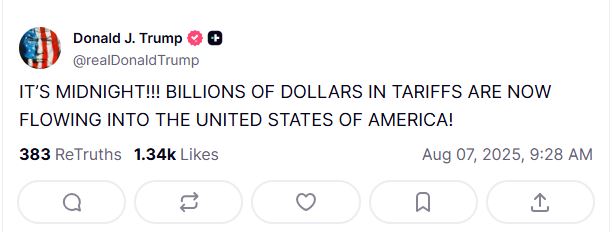
Trump administration hailed the considerably higher tariffs that have already gone into effect, correctly noting that they have raised more than USD 100 billion in tax revenue without leading to catastrophic inflation or a recession, as some economists had feared, as per CNN.
However, the tariffs on India were set to increase sharply due to an additional executive order signed by Trump, targeting India specifically for its continued purchase of Russian oil amid the Russia-Ukraine conflict.
This additional penalty tariff of 25% was scheduled to come into effect on August 27, 2025, effectively doubling the tariffs on Indian imports to 50%. This rate puts India among the highest tariff rates imposed by the United States on any major trading partner globally.
White House Trade Adviser Peter Navarro explained the rationale behind these tougher tariffs on India as fundamentally different from the usual "reciprocal" tariffs. He characterised the Indian tariffs as a national security measure, linked directly to India's refusal to cease buying Russian oil, which the U.S. claims indirectly funds Russia's war efforts in Ukraine.
Navarro remarked that the U.S. already imposes tariffs exceeding 50% on Chinese goods but is cautious not to harm its own economy while enforcing such measures on China. By contrast, the India tariffs were viewed as punitive to influence India's energy and foreign policy choices.
Trump himself took to social media, notably Truth Social, to announce that billions of dollars in tariff revenue were now flowing into the U.S. Treasury. Reports suggested that these tariffs could generate over $100 billion annually without triggering severe inflation or recession, as some economists had previously feared.
The impact on Indian exports is expected to be severe. Analysts and industry experts foresee that such high tariffs will increase costs, making Indian goods much more expensive in the U.S. market. This could lead to a reduction in U.S.-bound Indian exports by 40–50%, harming sectors such as leather, chemicals, footwear, gems and jewellery, textiles, and shrimp.
Some Indian exporters have indicated that they could not absorb significant tariff increases, making the combined 50% tariff almost equivalent to a trade embargo on affected products.
The tariffs' punitive aspect reflects the ongoing geopolitical tension surrounding energy trade and the Ukraine crisis rather than standard trade policy. India has criticised the additional levies as unfair and unjustified, asserting that its oil purchases are driven by market needs and energy security.
President Trump's tariff policy represents a marked escalation in trade tensions, particularly with India, highlighting a blend of economic and national security motives underpinning these aggressive trade measures. The administration's approach aims to leverage tariff impositions to influence geopolitical behaviour while simultaneously raising significant revenue for the U.S. government.
Based On ANI Report


No comments:
Post a Comment