Showing posts with label Congo. Show all posts

Wednesday, December 31, 2025

United Nations Organization Stabilisation Mission In The Democratic Republic of The Congo Honoured For Bravery And Commitment


India's Level-II Plus Hospital, previously known as the Level-III Hospital and deployed under the United Nations Organization Stabilization Mission in the Democratic Republic of the Congo (MONUSCO), has received a prestigious honour for its bravery and unwavering commitment in Goma.

The Special Representative of the Secretary-General (SRSG) and Head of MONUSCO Unit Appreciation was conferred upon the unit, recognising its exemplary professionalism, operational resilience, and outstanding contributions to the mission's mandate.

Col Rajesh W Adhau, the Contingent Commander, accepted the citation from Brig Salil MP, Commander of the Central Sector and Acting Deputy Force Commander, during the Medal Day Parade in Goma on 29 December 2025.

This accolade underscores India's steadfast dedication to United Nations peacekeeping efforts and bolsters its reputation as a reliable security partner on the global stage.

Following the presentation, a message from MONUSCO Force Commander Lt Gen Ulisses De Mesquita Gomes was relayed, paying tribute to the unit's leadership and the collective resolve of all ranks.

The Force Commander highlighted that medical units in high-risk zones must exhibit exceptional competence, resilience, and the capacity to instil confidence throughout the mission—qualities that the Indian hospital has exemplified with distinction.

The recognition specifically acknowledges the hospital's performance amid the fierce armed conflict in and around Goma during January and February 2025.

Despite facing crossfire, direct threats, and severe operational constraints, the unit maintained uninterrupted medical support, treating numerous conflict-related casualties.

It saved the lives of UN peacekeepers while extending care to civilians and local security personnel, demonstrating remarkable fortitude under duress.

In tandem with combat-related duties, the hospital adeptly managed public health crises, including outbreaks of Monkeypox, cholera, and tuberculosis, ensuring seamless continuity of care.

The unit's calm leadership, astute medical judgement, and seamless coordination with Force Headquarters and other contingents were pivotal in preventing any lapse in medical services. This coordination directly bolstered operational continuity and enhanced the overall credibility of the MONUSCO mission.

Beyond its clinical prowess, the India Level II Plus Hospital earned praise for promoting unity and collaboration across MONUSCO through various outreach initiatives.

It provided training support and medical assistance to contingents throughout the mission area, embodying the humanitarian spirit central to UN peacekeeping operations.

The conferment of this SRSG Unit Appreciation marks a significant milestone, celebrating the unit's discipline, leadership, and esprit de corps.

It serves as a testament to the professionalism of Indian peacekeepers operating in one of the world's most volatile regions. This honour reaffirms India's pivotal role as a dependable contributor to international peace and security.

Through its people-centric approach to peacekeeping, India continues to set benchmarks for medical support in conflict zones.

The achievement in Goma highlights the Indian Armed Forces' capability to deliver high-impact humanitarian aid amid adversity.

Such recognitions not only motivate serving personnel but also inspire future generations of peacekeepers.

India's contributions to MONUSCO exemplify its broader commitment to global stability, particularly in Africa. As the mission navigates ongoing challenges in the Democratic Republic of the Congo, the Indian hospital's legacy endures as a beacon of resilience and service.

Based On ANI Report


Thursday, July 10, 2025

Democratic Republic of Congo To Acquire Loitering Munitions An Private Indian Company


Armed Forces of the Democratic Republic of the Congo (FARDC) has placed orders for Indian-made loitering munitions from a private Indian company, most likely Solar Defence and Aerospace Ltd.

The DRC is also negotiating for anti-drone and suicide drone systems from Indian firms, including both private and state-owned enterprises.

This marks a strategic pivot away from Chinese suppliers, driven by operational needs and a desire for more effective, affordable, and maintainable defence solutions.

These developments underscore the growing defence partnership between India and the DRC, with India emerging as a key supplier of modern, mission-critical military technology to African nations.

This reported by Africa Intelligence and corroborated by multiple defence news outlets, marks a significant shift in the DRC’s defence procurement strategy, favouring India’s affordable and increasingly sophisticated defence solutions over traditional suppliers.

Since early 2025, there has been a notable increase in engagement between Indian defence manufacturers and the Congolese military. Regular interactions and visits, including a high-level DRC Ministry of Defence delegation to India, have strengthened this emerging security partnership.

The DRC’s interest is not limited to loitering munitions; negotiations are ongoing for a broader suite of equipment, including anti-drone systems and suicide attack drones.

Among the Indian companies involved, Solar Defence and Aerospace Ltd—a Nagpur-based private firm—has been highlighted as a key supplier of loitering munitions to both the Indian Army and foreign clients. Their Nagastra-1R loitering munition, for example, is capable of precision strikes, night operations, and features a reusable launcher system.

While the specific model ordered by the FARDC is not explicitly named in the reports, Solar Defence and Aerospace Ltd is a leading candidate given its recent contracts and export activities.

In addition to loitering munitions, the DRC is exploring anti-drone solutions from Indian state-owned and private companies. Bharat Electronics Limited (BEL), a government-owned enterprise, has demonstrated its “D4” anti-drone system to Congolese officials.

The D4 system can detect, track, and neutralize drones using both “soft kill” (jamming) and “hard kill” (kinetic) methods. Other Indian firms, such as Zen Technologies and Solar Defence and Aerospace Ltd (with its “Bhargavastra” system), are also offering advanced counter-UAV technologies.

This procurement shift is partly a response to dissatisfaction with Chinese weapons, which have been criticized by Congolese officials for poor frontline performance and maintenance challenges. The move toward Indian suppliers is seen as a bid for greater reliability, cost-effectiveness, and transparent support.

Based On African Intelligence Report


Wednesday, May 28, 2025

'After Losing Wars, Pak Chose Terrorism To Target India'


The Indian all-party parliamentary delegation, led by Shiv Sena MP Shrikant Shinde and including prominent figures such as BJP leader SS Ahluwalia, BJP MP Bansuri Swaraj, and former Ambassador Sujan Chinoy, delivered a forceful message during their diplomatic mission in the Democratic Republic of Congo (DRC).

The delegation’s primary objective was to brief international partners on India’s response to the April 22 Pahalgam terror attack, which claimed 26 lives, and to highlight India’s broader fight against cross-border terrorism, particularly emanating from Pakistan.

At a joint conference in Kinshasa, SS Ahluwalia underscored India’s longstanding concerns regarding Pakistan’s hostile actions. He asserted that after suffering defeats in three conventional wars with India—in 1965, 1971, and 1999—Pakistan shifted its strategy from open warfare to employing cross-border terrorism as a tool to destabilize India. Ahluwalia accused Pakistan of using terrorism as an instrument of state policy, with full support from its military, and warned that terrorism is a global threat, not limited to India alone.

BJP MP Bansuri Swaraj drew a poignant parallel between the suffering caused by terrorism in both India and the DRC, referencing the recent Pahalgam attack and the tragic loss of lives in Goma. She called upon the DRC to publicly condemn Pakistan’s role in cross-border terrorism and its support for attacks on Indian lives, emphasizing the shared pain of nations afflicted by terror.

Ambassador Sujan Chinoy added that Pakistan has consistently rejected peaceful relations and has obstructed progress and development in South Asia. He stressed that all bilateral issues between India and Pakistan must be resolved without international intervention, but urged the global community to recognize Pakistan’s role in promoting terrorism and to exert pressure on Islamabad to abandon violence in favor of peace.

The delegation’s outreach was part of a larger campaign following Operation Sindoor, India’s response to the Pahalgam attack, aimed at countering global misinformation and reinforcing India’s zero-tolerance policy on terrorism. The multi-party group met with key Congolese leaders, including the President of the Foreign Affairs Commission, Berthhold Ulungu Ekonda Lukata, and received assurances of solidarity from the DRC, which committed to echoing India’s anti-terrorism stance at international forums.

During these engagements, the Indian delegation reiterated that terrorism, especially when state-sponsored, is a global menace that must be confronted collectively. They presented evidence of Pakistan’s complicity, including its support for terror groups and the involvement of its military officials, and called for multilateral backing against terrorism at platforms such as the United Nations and the Financial Action Task Force (FATF).

The Indian delegation’s visit to the DRC was a concerted diplomatic effort to expose Pakistan’s continued use of terrorism as a strategic tool following its military defeats, to seek international condemnation and action, and to reaffirm India’s commitment to combating terrorism in all its forms.

Based On ANI Report


Saturday, February 1, 2025

'All Our Citizens Are Safe,' MEA Says On Democratic Republic of Congo Conflict


The Ministry of External Affairs (MEA) of India has confirmed that all Indian citizens in the Democratic Republic of Congo (DRC) are safe despite the ongoing conflict in the region.

This assurance comes as violence escalates, particularly around the eastern city of Goma, where clashes have resulted in significant casualties and displacement.

The UN reported that at least 700 people have been killed since the beginning of 2025, with over 400,000 individuals forced from their homes due to the conflict involving M23 rebels, who are reportedly advancing southward towards the capital, Kinshasa.

In light of the deteriorating security situation, the Indian government is closely monitoring developments and has taken measures to ensure the safety of its citizens in DRC.

The MEA emphasized its commitment to protecting Indian nationals amid rising tensions and humanitarian crises resulting from the violence.

ANI


Tuesday, October 15, 2024

Democratic Republic of Congo In Talks With HAL For TEJAS Jets: African Media


The Democratic Republic of Congo’s air force (FAC) is actively seeking to modernize its fleet, and India has become a focal point in their quest for advanced military aircraft. In August, a high-profile delegation from the FAC visited New Delhi to engage in discussions about the potential acquisition of the Tejas Mk1 multi-role aircraft. This visit marks a significant step in DR Congo’s efforts to replace its ageing fleet of Soviet-origin aircraft, including the Sukhoi Su-25s FrogFoot, reported Military Africa web portal.

The Congolese air force chief, alongside other defence officials, held extensive talks with representatives from Hindustan Aeronautics Limited (HAL), including notable aviation engineer Kota Harinarayana. The discussions centered around the performance and capabilities of the Tejas Mk1, and its potential to serve as a long-term replacement for the FAC’s existing Sukhoi Su-25s.

The FAC currently operates a diverse array of aircraft, including the Sukhoi Su-25, MiG-23, and Mil Mi-24 helicopters. The introduction of the Tejas Mk1 would represent a significant upgrade, bringing in more advanced technology and enhanced combat capabilities. This shift is seen as crucial for DR Congo to maintain a robust and modern air force capable of addressing contemporary security challenges.

The security situation in the Democratic Republic of the Congo (DRC) is volatile. Conflict between government forces and armed groups in the east is ongoing.

Furthermore, according to the United Nations, Uganda is backing M23 rebels fighting across its border in eastern Democratic Republic of Congo. The UN also warns that a rapidly escalating crisis “carried the risk of triggering a wider regional conflict”.

The Rwandan army is supporting M23 rebels in eastern DR Congo, using sophisticated weapons such as surface-to-air missiles. In January last year, Rwanda’s defence force shot at a Democratic Republic of Congo Sukhoi Su-25 ground attack jet with man portable air defence weapon (MANPAD) that allegedly violated its airspace, as tensions between the neighbouring countries escalate.

India’s Role In The Arms Trade

India has been making concerted efforts to expand its footprint in the global arms trade, aiming to compete with established players like Russia and China. By focusing on the African market, India hopes to provide cost-effective and reliable defence solutions to countries that may find Western-made equipment prohibitively expensive. The Tejas Mk1, developed and manufactured domestically, is a prime example of India’s capability to produce sophisticated and affordable military hardware.

The Appeal of TEJAS MK-1

The Tejas Mk1’s appeal lies in its advanced avionics, multi-role capabilities, and affordability. For African militaries, such as the FAC, these attributes make it an attractive option. India’s commitment to providing maintenance and support further enhances the reliability and cost-effectiveness of its defence systems.

Strengthening Ties And Market Presence

India’s strategy extends beyond just selling equipment; it aims to build long-term partnerships and establish a solid presence in the African defence market. By engaging with countries like DR Congo, India seeks to not only sell more of its domestically produced hardware but also gain access to new markets and strengthen its global influence.

Although, more than one year has past, and no sign of India’s affordable weapons to African forces.

On one hand, India’s Light Combat Aircraft (LCA) TEJAS MK-2 program is languishing without funding, months after the project was approved by New Delhi. The TEJAS MK-2 is intended to provide the Indian Air Force (IAF) with a 4.5-generation medium-weight-class fighter aircraft. The aircraft is designed to be an improvement over the fourth-generation TEJAS MK-1 aircraft currently in IAF service.

Meanwhile, the Botswana Defence Force is in talks with India’s state-owned Hindustan Aeronautics Limited (HAL) with a view to acquiring several of its TEJAS fighter jets.

In a move aimed at enhancing its defence capabilities, the Botswana Defence Force (BDF) is currently engaged in talks with Hindustan Aeronautics Limited (HAL), India’s state-owned aerospace and defence company.

Agencies


Tuesday, May 28, 2024

Major Radhika Sen of India To Receive Prestigious 2023 UN Military Gender Advocate of The Year Award


Major Radhika Sen, an Indian woman peacekeeper, who served with the UN mission in Congo, will be honoured with a prestigious military gender advocate award, with UN Secretary-General Antonio Guterres describing her as a "true leader and role model."

Major Sen, who served with the United Nations Organisation Stabilisation Mission in the Democratic Republic of the Congo (MONUSCO), will receive the prestigious '2023 United Nations Military Gender Advocate of the Year Award' from Guterres during a ceremony at the world body's headquarters here on May 30 marking the International Day of UN Peacekeepers.

She served in the East of the Democratic Republic of the Congo (DRC) from March 2023 to April 2024 as the Commander of MONUSCO's Engagement Platoon for the Indian Rapid Deployment Battalion (INDRDB), a UN press release said.

Born in Himachal Pradesh in 1993, she joined the Indian Army eight years ago. She graduated as a biotech engineer and was pursuing her Master's degree from IIT Bombay, when she decided to join the armed forces.

She was deployed to MONUSCO in March 2023 as the Engagement Platoon Commander with the Indian Rapid Deployment Battalion and completed her tenure in April 2024.

Major Sen is the second Indian peacekeeper to receive this prestigious award after Major Suman Gawani, who had served with the UN Mission in South Sudan (UNMISS) and was honoured with the 2019 United Nations Military Gender Advocate of the Year Award.

Congratulating Major Sen for her service, Guterres said she is a "true leader and role model. Her service was a true credit to the United Nations as a whole."

He further said in a statement that in an escalating conflict environment in North Kivu, her troops actively engaged with conflict-affected communities, including women and girls. She earned their trust, doing so with humility, compassion, and dedication.

The statement added that upon receiving news of the award, Major Sen expressed her gratitude for being selected and reflected on her peacekeeping role.

"This award is special to me as it gives recognition to the hard work put in by all the peacekeepers working in the challenging environment of DRC and giving their best to bring a positive change in the society," she said.

"Gender-sensitive peacekeeping is everybody's business - not just us, women. Peace begins with all of us in our beautiful diversity!"

Major Sen led mixed-gender engagement patrols and activities in a volatile environment, where many people, including women and children, were leaving everything behind to flee the conflict, the statement said.

Created in 2016, the United Nations 'Military Gender Advocate of the Year Award' recognises the dedication and efforts of an individual military peacekeeper in promoting the principles of UN Security Council Resolution 1325 on Women, Peace and Security.

Created by the Office of Military Affairs within the Department for Peace Operations (DPO), the Award recognises a military peacekeeper who has the best integrated a gender perspective into peacekeeping activities. Each year, the awardee is selected from among candidates nominated by Force Commanders and Heads of Mission from all peace operations, according to UN Peacekeeping.

India is currently the 11th largest contributor of women military peacekeepers to the United Nations with 124 now deployed. India has traditionally been among the largest troop and police-contributing countries to UN peacekeeping missions.

This report is auto-generated from a syndicated feed


Sunday, January 21, 2024

Felix Tshisekedi Sworn In As President of Congo For Second Term Amid Disputes


Kinshasa: Felix Tshisekedi was sworn in for the second term as the President of Democratic Republic of the Congo following highly contested elections in December last year, Al Jazeera reported on Saturday.

"I am taking back the baton of command that you entrusted to me. We want a more united, stronger and prosperous Congo," Tshisekedi (60) said during the inauguration ceremony in the capital on Saturday.

"I am aware of your expectations," he declared, referring among other things to unemployment, youth, women's rights and national cohesion.

With tensions simmering in the vast nation's volatile eastern provinces, the leader known as 'Fatshi' picked Kinshasa's 80,000-capacity Martyrs sports stadium for the inauguration ceremony.

Tshisekedi was first sworn in as president in January 2019, after a controversial victory against Joseph Kabila, according to Al Jazeera.

He won the first time promising to improve living conditions in the DRC - which boasts mineral riches but has a largely impoverished population of 100 million - and put an end to 25 years of bloodshed in the east.

Although, he did not succeed in achieving those promises, this time he campaigned strongly on his first-term achievements such as free primary medication, asking for another mandate to "consolidate" the progress.

The Congolese president made a landslide victory in the December 20 elections winning more than 70 per cent of the vote. The election had more than 40 per cent turnout, with some 18 million people voting, Al Jazeera reported.

Even before the results were announced in late December, opposition candidates - including businessman Moise Katumbi who finished behind Tshisekedi with 18 per cent of the vote -rejected the results and called on the population to mobilise.


Thursday, June 15, 2023

VP Dhankhar Hosts Leaders of Zimbabwe, Gambia, Congo; Discusses India-Africa Ties


New Delhi: Vice President Jagdeep Dhankhar hosted the leaders of Zimbabwe, The Gambia and Congo here on Thursday as India aims to strengthen the economic partnership with Africa and foster collaboration between businesses from both regions.

Dhankhar held discussions with Deputy PM of the Democratic Republic of the Congo Vital Kamarehe, Vice President of the Republic of The Gambia BS Jallow and Vice President of Zimbabwe Constantino Chiwengaa about India's ties and partnerships with their respective countries.

The leaders are in India to attend the 18th CII-EXIM Bank India Conclave on India-Africa Growth Partnership that is being held in the national capital from June 14 -16.

"Hon'ble Vice President, Shri Jagdeep Dhankhar hosted the leaders of Zimbabwe, The Gambia and Democratic Republic of the Congo in New Delhi today," the Vice President of India tweeted.

He met with Deputy PM of the Democratic Republic of the Congo Vital Kamarehe, Vice President of the Republic of The Gambia BS Jallow and Vice President of Zimbabwe Chiwenga.

Dhankhar discussed cementing the India-DRC partnership in various fields and improving ties and economic partnerships.

"H.E. Mr. Vital Kamerhe, Deputy PM of the Democratic Republic of the Congo called on the Hon'ble Vice-President of India, Shri Jagdeep Dhankhar in New Delhi today. Both leaders highlighted the strengthening of India-DRC partnership across diverse domains and bolstering people-to-people ties between the two nations," the Vice President tweeted.

In the meeting with his Gambia counterpart, Dhankhar discussed the strengthening of ties between the two countries.

"H.E. Mr. Muhammad B.S. Jallow, Vice President of Republic of The Gambia met Hon'ble Vice-President of India, Shri Jagdeep Dhankhar in New Delhi today. Both leaders discussed the further deepening of ties between the two nations, with special emphasis on trade and economic partnership," Dhankhar tweeted.

Dhankhar also met his Zimbabwe counterpart Chiwenga and discussed giving more momentum to the India-Zimbabwe partnership.

"Vice President of Zimbabwe, H.E. Gen. (Retd) Dr. Chiwenga met Hon'ble Vice-President of India, Shri Jagdeep Dhankhar in New Delhi today. Discussions focused on giving greater impetus to India-Zimbabwe multi-faceted partnership, and further strengthening ties between the nations," he tweeted following their meeting.

Speaking at the inaugural session "India-Africa: Synergies for ONE Growth" of CII-EXIM Bank India Conclave, Jaishankar said, "India's development partnership with Africa will have a strong focus on digital, green, healthcare, food security and water, in tune with the pressing priorities of Africa."

In the last sixteen editions, the Conclave has played a pivotal role in encouraging Indian companies to establish and grow their footprints in Africa.

Africa occupies an important place in India's Foreign Policy and during the last nine years, this has been consciously stepped up under the direction of PM Modi, said External Affairs Minister S Jaishankar on Wednesday in Delhi.

"Our ties are not transactional but represent the solidarity of a shared struggle. Africa, therefore, occupies an important place in India's foreign policy. During the last 9 years, this has been consciously stepped up under the direction of PM Modi," EAM said while addressing the 18th CII-EXIM Bank Conclave on the India-Africa growth partnership.

The EAM said that the "ties between India and Africa are not transactional but represent the solidarity of a shared struggle".

Jaishankar mentioned that India's engagement with Africa has been strengthened under the guidance of Prime Minister Modi.

"Our engagement with the continent has since witnessed 36 high-level visits from India and more than 100 high-level visits from Africa," Jaishankar added, while addressing the conclave in the National Capital.

The minister highlighted the support India provided to African countries during their fight for independence and against colonialism and apartheid.


Wednesday, June 14, 2023

Congo's Deputy PM Arrives In New Delhi To Attend CII-EXIM Bank Conclave


New Delhi: Deputy Prime Minister of Congo, Vital Kamerhe, has arrived in New Delhi to participate in the CII-Exim Bank conclave, informed the Ministry of External Affairs on Wednesday.

Taking to Twitter, MEA Spokesperson Arindam Bagchi said, "Deputy PM Vital Kamerhe of the Democratic Republic of Congo arrives in New Delhi to participate in the CII-EXIM Bank Conclave. An opportunity to bolster the - trade, economic and commercial partnership."

This year's, 18th edition of CII-Exim Bank Conclave on India-Africa Growth Partnership is scheduled to take place at Taj Palace, New Delhi from June 14 - 16.

Earlier today, Vice President of Zimbabwe Constantino Chiwenga also arrived in New Delhi.

"Warm welcome to Vice President Constantino Chiwenga of Zimbabwe as he arrives in New Delhi for CII-EXIM Bank Conclave. The visit will give boost to India-Zimbabwe development partnership and trade & economic ties," tweeted Arindam Bagchi, MEA official spokesperson.

The Conclave aims to strengthen the economic partnership between India and Africa and foster collaboration between businesses from both regions. It is an excellent opportunity for African businesses to showcase their potential and explore avenues for collaboration with their Indian counterparts.

The CII-EXIM Bank Conclave on India-Africa Project Partnership was launched in the year 2005 with the support of the Ministry of External Affairs and the Ministry of Commerce and Industry, the Government of India, according to CII-EXIM Africa Conclave's official website.

In the last sixteen editions, the Conclave has played a pivotal role in encouraging Indian companies to establish and grow their footprints in Africa.

According to the website, the level of economic engagement between India and Africa has grown multi-dimensional and to reflect the changing contours of this dynamic relationship, the Conclave is being rechristened as "CII-EXIM Bank Conclave on India Africa Growth Partnership" expanding the earlier focus on "Project Partnership".

The upcoming edition focussed on project exports, trade, investments, and exchange of knowledge and expertise creating shared value for business and industry at large between India and Africa.


Sunday, April 16, 2023

Democratic Republic of Congo To Audit Mining Deals Favouring China


Kinshasa: The Democratic Republic of Congo (DRC) is scrutinizing the mining contract concluded in 2008 with China, which is heavily skewed in favour of Beijing following the call for an overhaul of USD 6.2 billion mining deal with China in February 2023, reported US-based publication Quartz.

National assembly speaker Christophe Mboso has sought a proper audit of mining contracts with a strict review of the government's deals with "certain partners such as the Chinese contract."

Finance Minister Nicholas Kazadi has alleged that these contracts were skewed in favour of Beijing and wants the tax obligations on these companies increased, reported Quartz.

In February 2023, the impoverished but mineral-rich nation called for an overhaul of a USD 6.2 billion mining deal with China.

This followed President Felix Tshisekedi's demand for a bigger share of the country's vast mineral resources than that agreed upon by his predecessor.

"It is not normal that those with whom our country has signed exploitation contracts are getting richer while our people remain poor," President Tshisekedi said in May 2021. "It is time for the country to readjust its contracts with the miners in order to seal win-win partnerships."

Sicomines is a mining company owned by both DRC (32 per cent) and China with around 6.8 million tonnes in mineral reserves. It owns most of the 19 mines in the country.

DRC holds its stake in Sicomines through the state-run mining firm Gecamines. In exchange for China's 68 per cent share, Beijing-based Sinohydro Corp and China Railway Group agreed to build roads and hospitals for the central African nation of 95 million people, reported Quartz.

At 3.5 million metric tons, DRC has 70 per cent of the world's cobalt reserves, according to the UN. Around 80 per cent of the cobalt it produces goes to China for processing today. DRC is also Africa's largest copper producer.

"Sicomines, it seems, is not keen on paying the USD 200 million that the DRC is asking for after making huge profits," Kazadi said, as quoted by the East African newspaper on April 8. "They have to pay...," said Kazadi.

Notably, copper and cobalt are critical in the global switch to clean energy, as they are used in electric vehicle batteries, solar panels, and wind turbines, a field that China wants to continue dominating.

Former DRC President Joseph Kabila (2001-2019) negotiated a deal in 2008 which saw Congolese cobalt and copper exchanged for infrastructure construction by a Chinese consortium.

The original deal was worth USD 9 billion but was then renegotiated to USD 6 billion under pressure from the International Monetary Fund (IMF), reported The Brussels Times.

Considering the demand of copper and cobalt, Kinshasa is now dissatisfied. In February 2023, the state audit office Inspection Generale des Finances (IGF) asked for an additional USD 17 billion in infrastructure investment from China, looking to make such deals fairer to DRC.

An IGF report released at the time showed that Sicomines had so far invested USD 822 million on infrastructure projects in the DRC, despite earning USD 10 billion from contracts in the project over the past 10 years, reported Quartz.

IGF now wants China to increase its investment in Sicomines from the current USD 3 billion to USD 20 billion and also hire more Congolese staff.

President Tshisekedi, who will be seeking re-election in December, will use the issue in his campaign to right the Kabila regime's wrongs, observers have said, reported Quartz.


Sunday, March 12, 2023

China's Economic Coercion Increasing In The Developing World


Rome: China's growing economic footprint in many developing countries is causing a significant amount of debt repayment crisis after the financial challenges posed by the pandemic. China, which surpassed traditional multilateral institutions as the largest creditor to the developing world, has since the pandemic begun pressuring economically fragile nations in the developing world to repay their debts instead of granting relief for struggling economies, Geopolitica reported.

Specifically, the African continent has been granted excessive debt in order to gain influence over its natural resources. China has over the years become the largest bilateral creditor to African countries. Beijing has provided financial loans for infrastructural projects to more than 32 African nations including Angola, Ethiopia, Kenya, the Republic of Congo, Djibouti, Cameroon and Zambia in some recent years. Combined together the continent owes China a deficit of $93 billion dollars, which is predicted to reach $153 billion in the coming years.

Geopolitica reported that Zambia, in particular, has been on the receiving end of China's economic coercive means. Because of its default of USD 17 billion in 2020 with China as its largest creditor, the country has had to reach out to the G20 grouping to secure debt relief which still remains to be stalled due to Beijing's objections.

Another African nation, Kenya, has been facing significant internal instability due to overborrowing from China. Kenya's mounting Chinese debts are causing some serious consequences in the African nation. Beijing, which accounts for around a third of Kenya's debt, has led many to believe that successive Kenyan governments have over-borrowed for over-priced projects, Geopolitica reported.

This has not only left the East African nation in excessive debt, but it has overburdened the national economy as well, leading the general public to call for a transparent and accountable reassessment of Chinese investments in the country.

Geopolitica reported, South Asian countries like Sri Lanka and Pakistan have been struggling with their economic instability due to the excessive debt burden induced by Chinese finances too. For Colombo, last year a month-long scarcity of essential items that wreaked havoc on its population was in part caused by severe debt intake from Chinese investment banks. Up until 2020 Sri Lanka had borrowed up to 4.6 billion dollars, over and above a loan of $500 million in both 2020 and 2021 each, in order to ease off the strain on the island's foreign reserves. The two countries also signed a currency swap deal of $1.5 billion in 2021.

Yet, as the president of Sri Lanka himself claimed, Beijing had responded negatively to a 1.5 billion dollars credit line that it had agreed to over a year ago. The government's call of seeking a $1 billion dollar loan to buy essential items for the country too was ignored in times of economic difficulties for the island nation.

For Pakistan, one of China's closest allies in the region and also home to its largest investment in the form of the China-Pakistan-Economic-Corridor (CPEC), its cordial bilateral relationship with China has gone on to cost its economic freedom, which now seems to be dictated from Beijing. However, China's reliability as a partner had been put into question when media reports suggested that China had refused to assist Islamabad in its request to renegotiate power purchase agreements, further destressing Pakistan's already struggling economy significantly.

The IMF, on the other hand, has asked both Sri Lanka and Pakistan to renegotiate their deals on energy and infrastructure plans with China in the wake of these nations seeking urgent financial assistance from international institutes. Moreover, Beijing is yet to live up to its pledge of re-issuing loans to Pakistan amounting up to $4 billion and is yet to respond to Sri Lanka's plea for a USD 2.5 billion credit support.

These continuous trends of debt trap diplomacy have indeed brought forward the malicious details of Chinese intentions, whose loans to developing countries at commercial rates higher than the market rate with the promise of easy access to finances have a far deeper consequence for the recipient nation.

The severe indebtedness of countries ranging from the African continent to Asian countries has given China significant leverage, not only in these specific regions, but it has also brought to influence in international forums where such countries have to invariably side with Beijing due to its stifling influence over the indebted country.

Moreover, China's tactics of exemplifying white elephant projects that have generally been rendered useless around the world have also encapsulated true Chinese intentions of making developmental promises that more often than not fail in generating revenues.

China's growing influence on the developing world through such coercive means is not only detrimental to the global economy, but it is a dangerous pathway that requires to be countered through a collective effort of like-minded democratic nations.

The developing world needs to stand up to the Chinese strategy of providing unfavourable loans with conditions that intend to cripple economies and push them further into a debt burden.

Such plans can only be tackled when the developing countries attempt to see beyond short-term economic gains and view the treacherous path China has invariably embarked upon.

Thus, it is important that Chinese tactics are seen in the light of what it actually intends to do, i.e. destabilize internal economies to subsequently gain a stronghold over sovereign national economies and influence their decision-making processes.


Tuesday, February 14, 2023

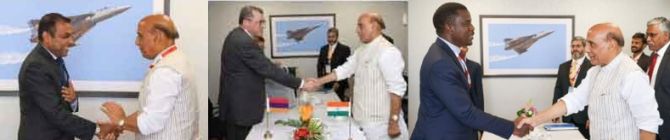
Rajnath Singh Holds Bilateral Meeting With Defence Heads of 7 Nations; Discusses Spectrum of Defence Cooperation


Bangalore: Defence minister Rajnath Singh on Monday held bilateral meetings with the defence heads of various countries on the sidelines of the Aero India show in Bangalore.

He held bilateral meetings with the defence heads of seven countries - Sri Lanka, Bangladesh, Nepal, Tanzania, Zimbabwe, Armenia and Congo.

He met with the Deputy Defence Minister of Armenia, Karen Brutyan; Congo's Minister of National Defence, Charles Richard Mondjo; Tanzania's Defence Minister, Basungwa Innocent Lugha; Defence Minister of Zimbabwe, Oppah Charm Zvinpange Muchinguri; Sri Lanka's Minister of State for Defence, Premitha Bandara Tennakoon; Defence Minister of Nepal, Hari Prasad Uprety; and Security Advisor to Bangladesh PM, Maj Gen Tarique Ahmed Siddique.

He also addressed the CEOs of local and global OEMs during a Round Table event in Bangalore and said that the Government of India is open to new ideas and is committed to fully harnessing the energy and capability of private sector partners in the area of defence production.

Today, Singh is scheduled to hold bilateral meetings with the defence heads of four other countries - the UK, Italy, Zambia and Maldives.

An important official source said that in the bilateral meetings, there was talk of buying and selling defence goods. Apart from this, India has assured countries who took part today in the bilateral meetings that India will cooperate in their capacity building in the defence sector.

India also gave assurance that they will help them to strengthen the defence goods which are almost lacking in their countries.

The entire spectrum of defence cooperation was discussed during the meetings, with a focus on identifying avenues to expand mutually beneficial collaboration.

After his meeting with Nepal's Defence Minister, Uprety, Singh tweeted, "Wonderful interaction with the Defence Minister of Nepal, Shri Hari Prasad Uprety on the sidelines of Aero India Show in Bengaluru. We look forward to continued cooperation to further deepen our close partnership and shared interests."

Earlier today, Prime Minister Narendra Modi inaugurated the 14th edition of Asia's biggest aero show - Aero India 2023 - at Air Force Station in Yelahanka, Bengaluru.

A commemorative stamp was also released by PM Modi on the occasion.

The five-day event, on the theme 'The runway to a billion opportunities', will showcase India's growth in aerospace and defence capabilities.

It will display indigenous equipment/technologies and forge partnerships with foreign companies, in line with the 'Make in India, Make for the World' vision for a secure and prosperous future.


Friday, February 3, 2023

143 Indian Troops Died On Duty In Africa Under Peacekeeping Missions Since UN's Inception: Government


As many as 143 Indian troops died on duty in Africa under UN peacekeeping missions since the United Nation's inception, the government said on Thursday. A total of 143 Indian UN peacekeeping troops died on duty in Africa under peacekeeping missions since the UN's inception, the government said on Thursday.

In a written reply to a question in Rajya Sabha, Minister of State for External Affairs V Muraleedharan said the total number of women troops who have died during UN's peacekeeping missions across the world is 35.

To a separate question, Muraleedharan said India continues to assist Sri Lanka in its economic development as also support it in overcoming its economic challenges, under India's 'Neighbourhood First' policy.

In January 2022, India extended a USD 400 million currency swap to Sri Lanka under the SAARC Framework and deferred successive Asian Clearing Union (A.C.U.) settlements of around USD 2 billion, he said.

A Line of Credit of USD 500 million was extended to Sri Lanka for importing fuel from India, he said.

"In addition, India has extended a credit facility of USD 1 billion for the procurement of food, medicines and other essential items from India. Humanitarian assistance was also provided to Sri Lanka by gifting essential medicines worth about INR 6 crores, 15,000 litres of kerosene oil and US $ 55 million LoC for procurement of Urea fertilizer," Muraleedharan said.

The Tamil Nadu government has contributed rice, milk powder and medicines worth US$ 16 million, as part of the larger Indian assistance effort, he added.


Monday, January 16, 2023

10 Killed, Several Wounded In Bomb Attack At Church In Democratic Republic of Congo


Kinshasa: At least 10 people were killed and several others got wounded in a bomb attack at a Protestant church in the eastern Democratic Republic of the Congo (DRC), said the country's army, reported Qatar-based TV Network Al Jazeera.

Congo army spokesman Anthony Mualushay on Sunday said that the explosion killed 10 people and wounded 39. Both tolls were provisional, he added.

According to Mualushay, the attack during the Sunday service in the city of Kasindi, on the border with Uganda, was carried out by the Allied Democratic Forces (ADF), a Ugandan armed group that has pledged allegiance to the Islamic State of Iraq and the Levant (ISIL).

The ISIL group, later on Sunday, claimed responsibility for the attack. The ADF, initially an uprising in Uganda, has been based in DRC since the late 1990s, Al Jazeera reported.

According to eyewitnesses, the blast severed some people's limbs from their bodies.

A campaign has been launched against the ADF by the Congolese and Ugandan forces in Congo's Kasindi province. The ADF pledged allegiance to the ISIL in mid-2019 and has been accused of killing hundreds of villagers in frequent raids over the past two years.

Troops from Uganda's army have deployed to eastern Congo to try to stem the violence, but the attacks have increased. ADF attacks since April 2022 have killed at least 370 civilians and involved the abduction of several hundred more, a report by the United Nations last month said, reported Al Jazeera.

ADF has extended its operation to Goma and into the neighbouring Ituri province.

According to Al Jazeera, more than 120 armed groups roam mineral-rich eastern DRC. Many are the legacy of regional wars that flared at the turn of the century.

India remains concerned about the "volatile security situation" in the eastern region of Congo. Ruchira Kamboj, Permanent Representative of India to the United Nations, said that the activities of armed groups have continued unabated which has resulted in killings of civilians, displacement of people and caused a "dire humanitarian situation."

"India remains concerned at the volatile security situation in the eastern DRC (The Democratic Republic of the Congo). The activities of armed groups have continued unabated, resulting in killings of civilians, displacement of the population and a dire humanitarian situation," Ruchira Kamboj said.

In her address at the UN Security Council, Kamboj said that India with concern notes the rise in the scale of attacks carried out by the Allied Democratic Forces (ADF), including the use of improvised explosive devices. She emphasised that the threat of terrorism in Congo cannot be ignored keeping in view the established terrorist links within armed groups. She stated that India has "long-standing relations" with Congo and added that they will continue to support the people of Congo.


Saturday, December 10, 2022

India Remains 'Concerned On Volatile Security Situation' In Eastern Congo: India


New York: India remains concerned about the "volatile security situation" in the eastern region of Congo. Ruchira Kamboj, Permanent Representative of India to the United Nations, said that the activities of armed groups have continued unabated which has resulted in killings of civilians, displacement of people and caused a "dire humanitarian situation."

"India remains concerned at the volatile security situation in the eastern DRC (The Democratic Republic of the Congo). The activities of armed groups have continued unabated, resulting in killings of civilians, displacement of the population and a dire humanitarian situation," Ruchira Kamboj said.

"The M23 group is expanding its territorial control in the eastern DRC, and its movement towards Goma is a matter of deep concern," she added.

In her address at the UN Security Council, Kamboj said that India with concern notes the rise in the scale of attacks carried out by the Allied Democratic Forces (ADF), including the use of improvised explosive devices. She emphasised that the threat of terrorism in Congo cannot be ignored keeping in view the established terrorist links within armed groups. She stated that India has "long-standing relations" with Congo and added that they will continue to support the people of Congo.

"India has long-standing relations with the DRC. We recall with immense satisfaction our contribution to protect its territorial integrity in March 1961 during the Katanga province crisis," Ruchira Kamboj said.

"India remains committed to playing its part in supporting the people of DRC on their path towards securing lasting peace, stability, and prosperity," she added.

India's permanent representative to the United Nations welcomed the role played by the wider region in opening up the political space for dialogue. She stressed that the decisions taken at the Luanda 'Mini Summit' held in November must be followed by all armed groups, including the M-23.

Furthermore, Kamboj underscored that India welcomes the allocation of USD 6 million to start the pilot phase of the P-DDRCS (Program for Disarmament, Demobilization, Community Recovery and Stabilization) projects in eastern Congo. She highlighted the importance of a long-term commitment to outcomes, deeper community participation and transparent procedure while implementing these projects.

Ruchira Kamboj noted that MONUSCO peacekeepers have been working in an "extremely challenging environment, both operationally and politically." She asserted that the lack of clarity in the mission's mandate and creative interpretation has further added to the existing complexities and increased the gap between people's expectations and MONUSCO's delivery.

"We also reiterate the importance of implementation of resolution 2589 to deter a culture of impunity through greater accountability for crimes against peacekeepers. As one of the largest Troop contributing Country, we are cognizant of the challenges to peacekeeping in the eastern DRC, and are fully committed to the implementation of MONUSCO's mandate," Ruchira Kamboj said.

In her address, Kamboj said India acknowledges the efforts made so far towards a steady transaction and the Joint Transition Plan agreed between MONUSCO and the Congo authorities. She underscored that the assessment of progress should be "realistic."

Ruchira Kamboj further said, "The situation on the ground should guide the eventual drawdown while ensuring that gains made in the violence-prone provinces are secured on a firmer footing first, so as to avoid any reversal." She stated that the transition and exit of MONUSCO must be "gradual, responsible and orderly."

Lauding the efforts of Congo leadership, Kamboj said that the Congo authorities have been taking initiatives to address existing challenges, including the security situation in the eastern part. She stated that India welcomes the preparations for the next general elections.